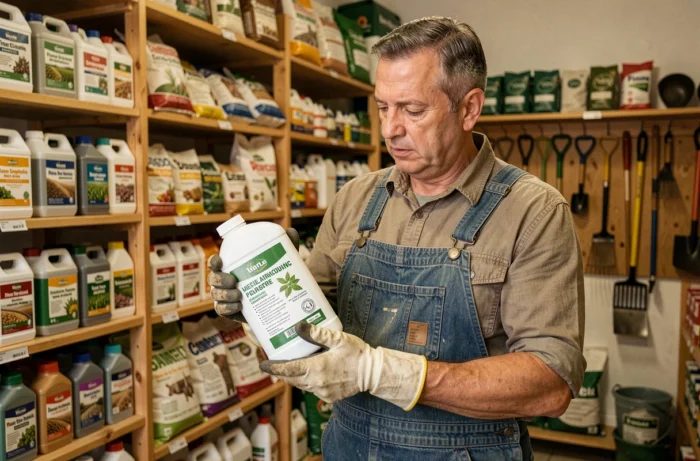
In Portugal, glyphosate is available over the counter in agricultural cooperatives, rural supply stores, and even online. The ease of access gives the impression that purchasing it is harmless. However, Portuguese regulations impose precise checks before any transaction, and a product displayed on the shelf may not necessarily be usable in your situation or in your country of residence.
National Authorization DGAV: the document that no one checks
The European Union has renewed the approval of glyphosate as an active substance. One might conclude that any glyphosate-based product is automatically legal in Portugal. This is false.
Each commercial formulation (the brand, concentration, co-formulants) must obtain a market authorization issued by the DGAV, the Portuguese phytosanitary authority. A product may contain glyphosate approved at the European level and still lack this national authorization. Without it, the sale is illegal, and use exposes one to sanctions.
Specifically, one should look for the Portuguese authorization number on the product label. This number confirms that the specific formulation has been evaluated and validated by the DGAV. If the seller cannot provide it, or if the label only mentions an authorization from another European country, the product is not compliant for sale in Portuguese territory.
Before placing an order, it is relevant to consult a dedicated guide to buy glyphosate in Portugal by checking each regulatory point.
Phytosanitary Certification in Portugal: who can legally purchase
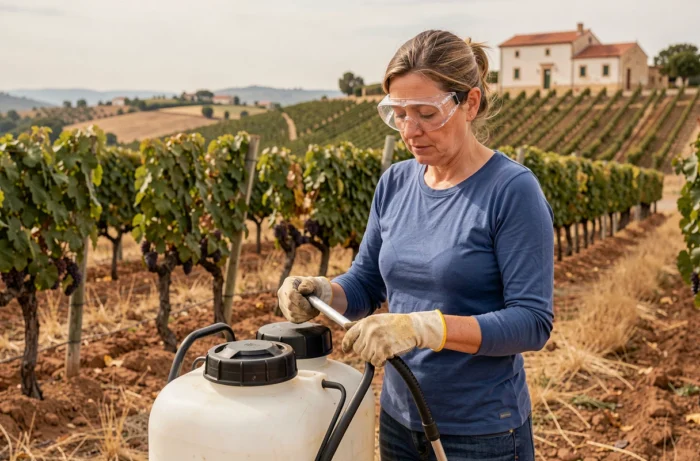
The Portuguese framework clearly distinguishes between professional users and individuals. In France, the sale of glyphosate to individuals has been prohibited since the Labbé law. In Portugal, professional purchase is conditioned on a phytosanitary certification issued after training in the handling of phytopharmaceutical products.
This certification is not an optional administrative formality. Portuguese agricultural retailers are required to ask for it. It certifies that the buyer understands the rules of dosage, pre-harvest intervals, spraying distances from watercourses, and storage obligations.
What the Portuguese certification covers
- The training covers the identification of health and environmental risks associated with phytopharmaceutical products, not just glyphosate
- It is governed by Portuguese Decree-Law No. 101/2009 and its successive amendments, which transpose the European directive on the sustainable use of pesticides
- The certificate has a limited validity period and must be renewed, which involves attending update sessions
A French buyer traveling to Portugal to acquire glyphosate must understand that presenting a French certification (the Certiphyto) does not guarantee acceptance by a Portuguese seller. Responses on this point vary depending on the stores and regions.
Glyphosate purchased in Portugal and used in France: the regulatory trap
This is the most common and misunderstood scenario. One buys a canister of glyphosate in Portugal, brings it back to France to treat agricultural land or a fallow plot. The product was legal at the time of purchase, so it seems logical to use it at home.
A product authorized in Portugal is not automatically authorized in France. Each member state issues its own market authorizations. A glyphosate 360 g/L sold legally in Lisbon may not be listed in the French register managed by ANSES. Using it in French territory without national authorization constitutes an offense.
This mechanism applies in both directions. A product authorized in France is not necessarily authorized in Spain or Belgium. The active substance (glyphosate) may be approved at the EU level, but each commercial formulation follows a country-by-country authorization process.
Checks to make before using an imported product
- Search for the exact commercial name of the product in the e-phy database of ANSES (for France) or in the equivalent register of the destination country
- Compare the concentration of active substance and co-formulants: two products may have similar names but different compositions
- Verify that the authorized uses correspond to your situation (crops, fruit growing, non-agricultural areas), as an authorization may be restricted to certain types of plots
- Keep the original label and purchase invoice, which serve as proof in case of inspection
Labeling and concentration of glyphosate 360: read before buying
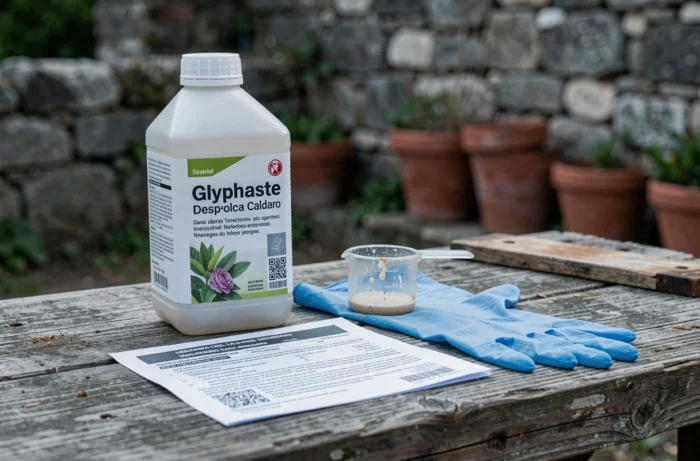
The most common concentration in products sold in Portugal is glyphosate 360 g/L. This dosage corresponds to the historical formulation that most European farmers are familiar with. It is found under dozens of different brands, complicating comparison.
On the Portuguese label, several elements deserve special attention. The DGAV authorization number must be clearly visible, along with the name of the authorization holder. The hazard pictograms and risk phrases (H and P statements) must be written in Portuguese, confirming that the product is indeed intended for the local market and not re-imported from a third country.
A product with a label solely in English or Spanish, without Portuguese translation, indicates either an unregulated parallel import or a counterfeit. In either case, caution dictates not to purchase.
Glyphosate remains the most widely used herbicide in the world, and its regulatory framework evolves with each renewal of European authorization. Checking national authorization, buyer certification, and compliance with the country of use constitutes the minimal triptych before any transaction. Ignoring any of these three points exposes one to sanctions, as well as the use of a product potentially non-compliant with current safety standards.