You pick a fig that is still firm and greenish, you take a bite, and a burning sensation fills your lips. This tingling is not trivial. The immature fig contains irritating substances that can affect the skin, mouth, and digestive system. Understanding these mechanisms can help avoid sometimes serious discomfort, whether you are an amateur gardener or a simple consumer.
Ficin and furocoumarins: what a green fig really contains
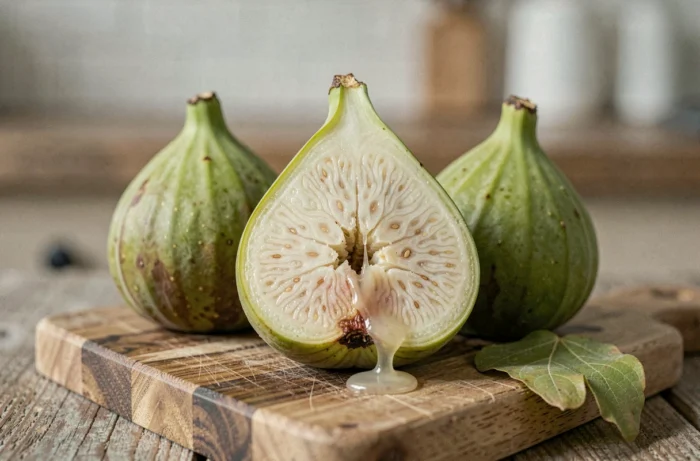
Before discussing toxicity, we must name the culprits. The unripe fig contains two types of problematic substances, concentrated in the white latex that oozes when the stem or skin of the fruit is broken.
The first is ficin, a proteolytic enzyme. It breaks down proteins upon contact with mucous membranes. In the mouth, it causes that characteristic burning sensation that many confuse with an allergy. In reality, ficin directly attacks the tissues, without the immune system being involved.
The second family of compounds, furocoumarins, reacts with UVA rays from the sun. This mechanism has a specific name: phytophotodermatitis. Anyone can fall victim to it after sufficient contact with the sap, followed by sun exposure. It is not an allergy, but a direct chemical reaction between the plant compound and ultraviolet rays.
As detailed in a report on the toxic unripe fig according to the Institut Droit & Santé, these two substances are much more concentrated in the immature fruit than in the ripe fig, where their levels decrease significantly as sugars develop.

Skin burns after contact with fig tree sap
Have you ever noticed brown spots on your hands after pruning a fig tree in the middle of summer? That’s phytophotodermatitis in action. The scenario is always the same: the sap settles on the skin, and the sun does the rest.
Symptoms often delayed
The trap is the delay. Redness or blisters do not appear immediately. Lesions occur between 24 and 72 hours after contact, making it difficult to identify the cause. Many people consult a doctor for an unexplained burn, without linking it to handling the fig tree a few days earlier.
The shape of the lesions aids in diagnosis. Traces in drips, splashes, or leaf imprints point to plant exposure. Without this information, the doctor may confuse the reaction with a thermal burn or classic contact dermatitis.
Marks that persist for several months
Even after the blisters heal, brown hyperpigmentation may remain visible for several months. These marks fade slowly, but they are more pronounced the longer the sun exposure has been. On darker skin, the residual pigmentation is often more pronounced.
Oral irritations and digestive disorders related to the immature fig
Biting into an unripe fig does not carry the same level of risk as skin contact followed by sun exposure. The consequences remain unpleasant.
Ficin attacks the oral mucosa and causes tingling, a burning sensation on the tongue, and sometimes swelling of the lips. These symptoms appear within minutes and usually disappear within a few hours.
Digestive disorders, on the other hand, vary according to the amount ingested: nausea, abdominal cramps, diarrhea. A child who eats several green figs in a garden is likely to experience more pronounced symptoms than an adult who tastes just one. The concentration of ficin and latex is the key variable.
A common point of confusion: these reactions are not food allergies. The oral allergy syndrome to figs does exist (especially in people allergic to birch pollen or rubber latex), but it also manifests with ripe figs. If symptoms only occur with green figs and disappear with ripe fruits, it is the ficin that is to blame, not an allergy.
Harvesting and handling precautions for the fig tree
Avoiding problems related to fig tree sap relies on simple gestures, but they must become systematic as soon as you intervene on the tree.
- Wear gloves and long sleeves when pruning or harvesting, even on cloudy days (UVA rays penetrate light clouds)
- Immediately wash any area of skin that has come into contact with the sap, with soap and water, to remove residues before they react to UV
- Stay out of the sun after contact with the sap, even if you have washed the skin: sunscreen alone is not enough to block the phototoxic reaction
- Only pick figs that are soft to the touch, with skin showing fine cracks: these are reliable signs of full maturity
For figs harvested a bit too early, a quick blanching in boiling water can neutralize some of the ficin and bitterness. Dip the fruits for a few minutes in simmering water before cooking them into jam or compote.
Green fig in the kitchen: distinguishing immaturity from variety
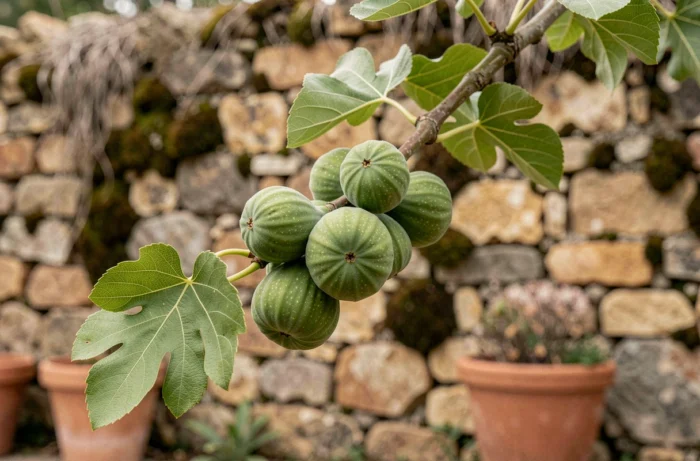
Not all green figs are unripe. Some varieties, like Kadota or the Marseille fig, remain green at full maturity. Color alone is therefore not enough to judge the ripeness of a fig.
- A ripe fig, regardless of its color, yields under slight thumb pressure
- Its peduncle bends downward under the weight of the sugar-laden fruit
- The skin shows small cracks and emits a sweet fragrance
A hard fig, which resists pressure and whose stem remains rigid, is not ready. Putting it back on the tree for a few more days significantly reduces the concentration of ficin and furocoumarins. Patience remains the best precaution.
The risks associated with the immature fig are real but perfectly avoidable. Recognizing the ripeness of the fruit, protecting your skin during harvesting, and washing away any trace of sap before exposing yourself to the sun: these three reflexes are enough to enjoy the fig tree without unpleasant surprises.