Between the end of the ceremony and the start of the cocktail hour, the couple’s photo session often takes longer than expected. Guests find themselves standing in a garden, empty glass in hand, not knowing what to do. This lull in the schedule is the most underestimated moment of the day, yet it is where the wedding’s atmosphere is created.
Coordinating Photographer and Entertainment to Eliminate Downtime
The classic reflex is to book a photographer on one side, a DJ on the other, and a caterer in their corner. The problem arises when no one communicates about the actual timing. If the couple’s photo session runs over, the caterer waits, the DJ loops the same tracks, and the guests lose interest.
It’s beneficial to treat the photographer, DJ, and caterer as a coordinated trio. Specifically, a shared schedule is set up with fixed slots for group photos, couple photos, and the start of the cocktail hour. The photographer announces a short time slot, optimized for the late afternoon light (the famous golden hour), and the DJ knows exactly when to kick off the first activity.
This coordination avoids the dreaded scenario: guests wandering for three-quarters of an hour waiting for the couple to return. You can also see tips on Info Mariage to refine this type of shared planning among vendors.
Photo Challenges Connected via QR Code: Turning Guests into Reporters
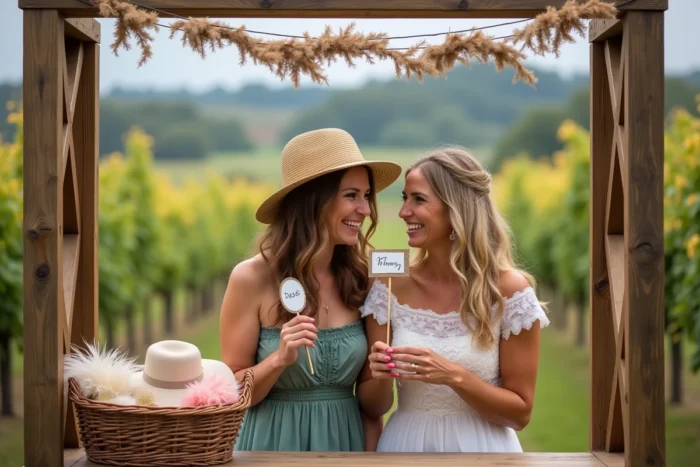
Wedding forums often recommend a photobooth with props. The problem with the classic photobooth is that it only works in a fixed location, often set up for the evening, not for the waiting period between the ceremony and the meal.
Recently, photo challenges via QR code have changed the game. The principle: cards with a QR code are distributed that each guest scans with their phone. Behind it, a list of personalized challenges (“photograph the most original outfit,” “capture a laugh between two strangers,” “find the hidden detail in the table decor”). The photos are instantly sent to a shared album accessible by the couple.
Services like Love Album offer personalized challenge cards with direct upload to an online album. The advantage over a fixed photobooth: guests move around, explore the venue, and produce spontaneous photos that the official photographer would never have captured.
What Makes a Difference on the Ground
A QR code alone is not enough. It’s best to prepare about ten varied challenges, mixing easy tasks (“selfie with the best man”) and tasks that encourage people to talk to each other (“find someone who has known the couple longer than you”). Feedback varies on this point, but challenges that encourage interaction between tables work better than purely visual ones.
Self-Sufficient Activities to Keep Guests Engaged Without a Host
Hiring a magician or setting up an escape game is an option, but it’s not suitable for all budgets or venues. For the specific time slot for photos, we look for activities that run on their own, without a vendor needing to be present.
Here are formats that work well for a thirty to forty-five minute slot:
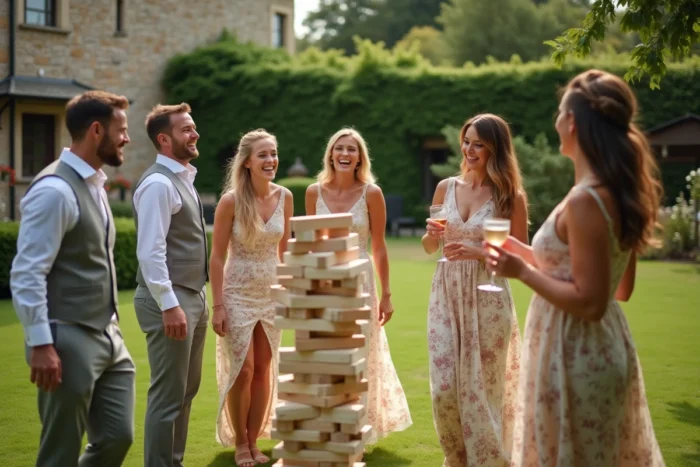
- Large-format board games set up outdoors (like giant mikado, wooden puck games): they attract both children and adults and require no lengthy explanations.
- A revamped guest book with specific instructions, for example, writing a memory with the couple on a card to hang on a wish tree, or slipping a message into a time capsule that the couple will open a year later.
- A self-service creative workshop (cookie decorating, small bouquet making): just prepare the materials in advance and display the steps on a board.
- A designated kids’ corner with coloring, face painting, and quiet games, ideally supervised by a dedicated babysitter so parents can enjoy the moment.
The common point of these activities: they do not depend on a master of ceremonies. They are set up before the guests arrive and operate independently.
Realistic Planning for the Photo Session and Cocktail
Couples often plan for two hours of photos after the ceremony. On paper, this seems reasonable. In practice, beyond forty-five minutes of absence, guests lose interest, even with activities in place.
The format that works best is to split the session into two blocks:
- Group photos (family, witnesses, close friends) immediately after the ceremony, while everyone is still gathered. This slot lasts about fifteen minutes.
- Couple photos shifted to the end of the cocktail or during a break in the meal, when guests are busy eating and chatting. The photographer benefits from better light, and the couple does not “disappear” when the group’s energy is at its highest.
With this division, the actual downtime between the ceremony and cocktail is reduced to just a few minutes. Guests move directly to activities and the wine reception without a lull. The caterer can start serving the first appetizers as soon as the group photos are done, and the DJ can follow up with a light musical ambiance.
Adapting the Plan to the Venue
A venue with a large park offers more latitude than a hall in the city center. If the location allows free movement between indoors and outdoors, large-format games and photo challenges make perfect sense. In a more confined space, we focus on the guest book, table games, and a carefully curated musical background to maintain the atmosphere.
The real lever for keeping guests occupied during the wedding photos is not to multiply activities, but to reduce the couple’s absence time and fill what remains with two or three well-placed activities. A tight schedule, vendors who communicate, and a handful of photo challenges are enough to turn a downtime into a moment that guests remember.