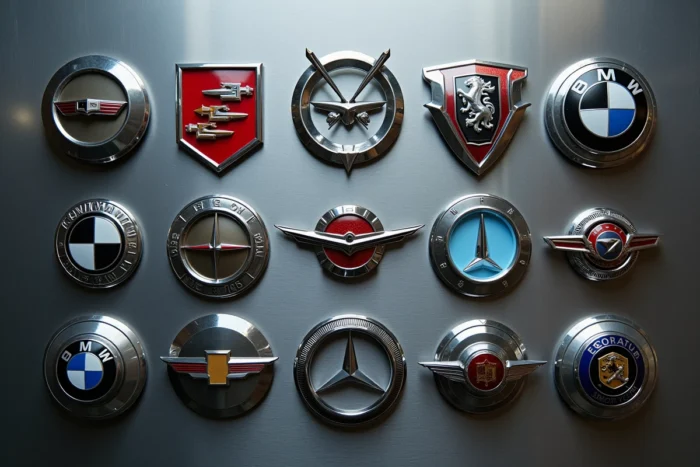
When trying to identify a vehicle in a parking lot or in an online ad, the first instinct is to look at the logo on the grille. A crest, a stylized animal, three letters: each manufacturer condenses its identity into a few square centimeters of metal or pixels. Understanding these symbols is also reading the industrial history of the automobile, from Germany to Japan, passing through France and the United States.
Animated logos and digital registration: what changes for manufacturers in 2026
Since July 2026, the EUIPO (European Union Intellectual Property Office) imposes a new technical framework for registering a car logo as a design or model of the EU. Manufacturers no longer protect just a static image: a logo can now be registered in an animated version in MP4 format.
The accepted formats are strictly standardized. JPEG for static views, OBJ or STL for 3D representations, MP4 for animations. Each registration allows up to ten static views per model, compared to seven previously.
The background must remain neutral, and “visual disclaimers” allow for the exclusion of unclaimed decorative elements from protection (the hood, the grille on which the logo appears). In practice, when browsing a list of car brands with their logo, we are looking at symbols that are also legal assets protected under several layers: word mark, figurative mark, and digital design or model.
This reform directly affects recent redesigns. The new Jaguar logo or the revamped Peugeot lion are no longer just graphic choices: their protection covers the startup animation on the dashboard, the icon in the mobile app, and even the representation in a 3D configurator.
Recognizing car brand logos by graphic family
Rather than memorizing hundreds of symbols one by one, it is more efficient to classify logos by type of representation. Most global manufacturers fall into four major visual families.
- Coats of arms and shields: Porsche, Alfa Romeo, Lancia. These logos often incorporate the coat of arms of the manufacturer’s city of origin. The Porsche crest features the rearing horse of Stuttgart and the stag horns of Württemberg.
- Stylized animals: Ferrari (rearing horse), Lamborghini (bull), Peugeot (lion), Jaguar (leaping feline). The animal conveys a promise of power or agility.
- Monograms and letters: BMW, Audi, Volkswagen, Kia. The blue and white circle of BMW evokes an airplane propeller, recalling the Bavarian firm’s initial activity in aviation engines.
- Abstract geometric shapes: Renault (diamond), Citroën (chevrons), Mercedes (three-pointed star). The Mercedes star symbolizes dominance on land, sea, and air.
This framework also works for lesser-known brands. An animal logo on an unknown car often points to a European manufacturer with a sporty focus. A clean monogram frequently indicates a recent Asian brand.
German manufacturer logos: a coherent visual code
Germany is home to several of the most recognized logos in the world. BMW, Mercedes, Audi, Porsche, and Volkswagen share one characteristic: circularity dominates, with a circle as the main frame. The four rings of Audi represent the merger of four manufacturers in 1932 (Audi, DKW, Horch, Wanderer). The Mercedes star has never changed its fundamental shape in over a century.
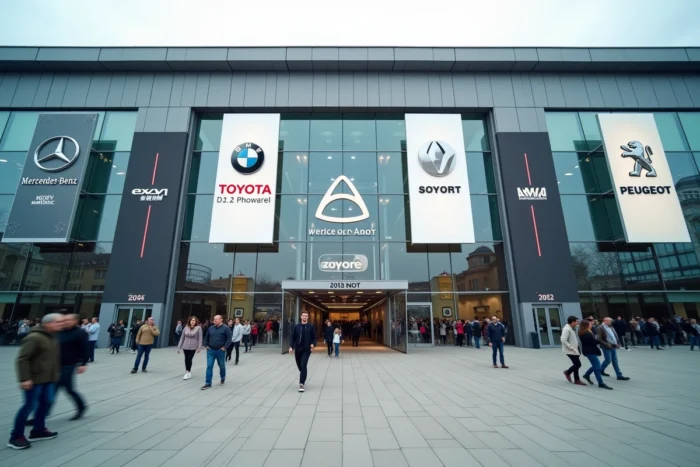
Car brands and electric vehicles: logos simplify
The underlying trend from 2024 to 2026 is minimalism. Manufacturers launching electric ranges are adopting flat, monochrome, and relief-free logos. The shift is from three-dimensional chrome to a flat design suitable for screens.
Volkswagen initiated the movement with a redesigned, thinner logo. BMW followed with a transparent version of its blue and white circle. Logos are becoming app icons before being hood ornaments.
This simplification is not just aesthetic. A flat logo reads better on a touchscreen dashboard, on a charging station, or in a mobile notification. Manufacturers are now thinking “screen first,” and the physical badge on the vehicle reflects the digital design, not the other way around.
Chinese brands and new logos in the European market
The arrival of Chinese manufacturers (BYD, MG under SAIC, NIO) adds logos that are still unfamiliar on European roads. These brands focus on clean geometric shapes, sometimes resembling technological logos. The return of MG, historically British, comes with a modernized octagonal logo that retains the original initials.
Reactions vary regarding the memorization of these new symbols: some motorists confuse them with logos of electronic equipment manufacturers. The proliferation of brands in the market makes a graphic family approach even more useful.
Classic car logos: identifying a collector vehicle
In the classic car market, the original logo is a criterion of authenticity that directly influences value. A refurbished badge or one that does not conform to the production year can significantly lower an estimate.
Classic car logos have often undergone several redesigns. The Renault diamond has seen more than ten versions since the brand’s inception. The Citroën chevron has refined over the decades. For collectors, identifying the correct version of the logo allows them to date a vehicle and verify the consistency of a restoration.
Body parts, including badges and emblems, are also subject to a new legal regime in the EU. The 2026 reform on designs and models includes a repair clause that regulates the reproduction of visible parts, including logos.
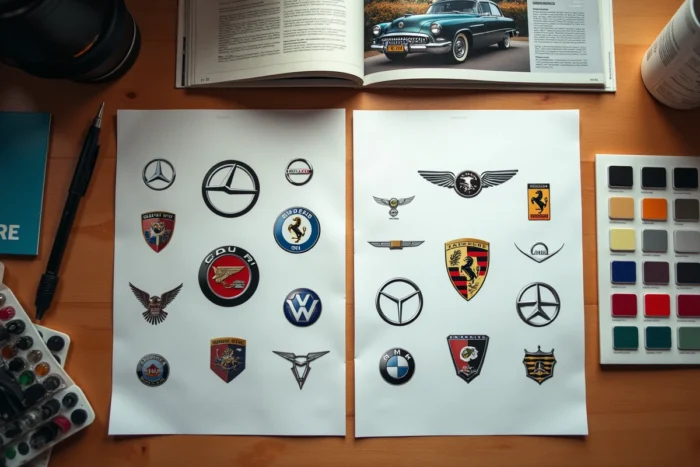
Identifying a manufacturer by its logo remains the quickest gesture to locate a vehicle within its brand universe. With the proliferation of manufacturers in the European market and the digitization of visual identities, these few square centimeters of design now condense as much legal strategy as graphic heritage.