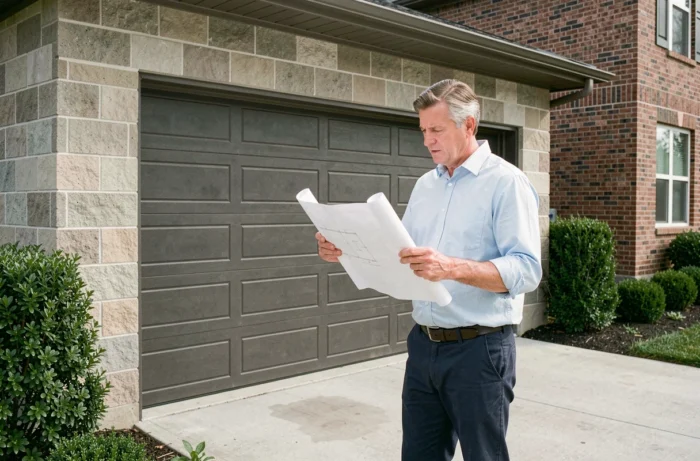
A garage project attached to the house, a standalone shelter at the back of the lot, an extension to park a second vehicle: in each case, the development tax applies as soon as the urban planning authorization is obtained. The amount can vary from simple to triple depending on the chosen configuration, and some technical details often go unnoticed at the time of filing the application.
Basement garage or attached garage: a different taxable base
It is often thought that the area of a garage is calculated the same way, regardless of its location on the plot. In practice, the position of the garage in relation to the main building changes the tax implications.
A garage located in the basement or within the vertical projection of the building may be treated differently from an attached garage built outside of this projection. This distinction, rarely detailed in public guides, directly modifies the taxable base of the development tax.
Specifically, if a garage is integrated under the house, its area is included in the overall calculation of the taxable area of the building. For a detached garage or simply attached but outside the vertical projection, the taxable area is calculated independently. Before submitting a permit, it is better to check with the local urban planning department what treatment will be applied, as responses vary on this point depending on the municipalities.
The question of development tax and garage deserves to be asked early in the project, ideally before choosing the location, to avoid an unpleasant surprise regarding the final amount.
Development tax rate for a garage: what determines the calculation
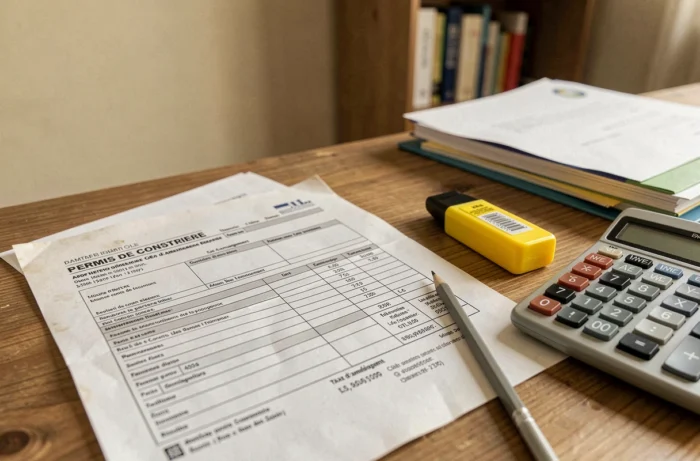
The amount of the tax is based on three combined variables: the created taxable area, a flat rate per square meter revised annually by ministerial decree, and the rates voted by the municipality and the department.
- The annual flat rate is set at the national level (outside Île-de-France, it differs slightly from that applicable in the Paris region). It applies to the square meter of enclosed and covered area.
- The municipal rate generally ranges from 1% to 5%, but can be increased up to 20% in certain areas identified as requiring significant development work.
- The departmental rate is added to the municipal rate, and in Île-de-France, a regional rate completes the total.
A point often overlooked: the applicable rate is that in effect at the time of the urban planning authorization, not that at the end of the construction. If the work spans two years and rates increase in the meantime, the calculation remains fixed at the date of the permit or the absence of opposition to the prior declaration. This rule can work in favor of the owner when rates rise, but it also prevents benefiting from a potential future decrease.
Prior declaration or building permit: the surface threshold that changes everything
The nature of the authorization directly depends on the size of the garage. A floor area or ground footprint created greater than 5 m² and less than or equal to 20 m² falls under a prior declaration. Beyond 20 m², a building permit is required.
This distinction is not purely administrative. The building permit requires a more complete file (site plan, cross-section, landscape integration), and the processing time is longer. For a modest-sized garage, the prior declaration is sufficient and speeds up the start of the construction.
In both cases, the development tax is due as soon as the authorization is issued. There is no minimum threshold below which the garage would be exempt by default. Even a small enclosed and covered shelter of a few square meters generates a taxable area.
The trap of reconstruction after demolition
Demolishing an existing garage to rebuild a larger one does not reset the counters to zero. The taxable area corresponds to the entirety of the new construction. The area of the old demolished garage is not automatically deducted, except in specific cases governed by the urban planning code. Before starting a demolition-reconstruction, it is better to request a simulation from the tax office or the town hall.

Transforming a garage into a living space: a new possible tax
Converting an existing garage into a bedroom, office, or living room seems trivial since the area is already built. In reality, this change of use can trigger a new tax assessment.
The garage, as a parking space, does not create floor area in the sense of the urban planning code. It only generates taxable area. When it is transformed into a habitable room, it potentially creates floor area that did not exist before. This shift can lead to new taxation, even if the initial garage had already been subject to a development tax during its construction.
This transformation generally requires a prior declaration, or even a building permit if it involves changes to the façade. It also has consequences for property tax and, in some cases, for residual housing tax.
Payment schedule since the 2022 reform
For authorizations issued since September 1, 2022, the procedure has changed. The declaration is made after the completion of the work, via the “Manage my real estate” space on the tax website, generally within 90 days following the end of the construction.
Payment then occurs in one or two installments depending on the amount. Before this date, the tax was settled directly by the administration based on the elements of the permit. You now declare the actual constructed area yourself, which holds the owner accountable but also opens the possibility to correct an initial area error.
This change in schedule means that you no longer receive the tax notice a few months after the permit, but well after the actual end of the construction. For a garage whose construction lasts several months, the cash flow gap can be significant compared to the old system.
Anticipating the amount of the tax from the design phase of the garage remains the best way to avoid a budget discrepancy. The simulators available on the websites of the departmental directorates of territories provide a reliable estimate, provided that the current municipal and departmental rates are entered.