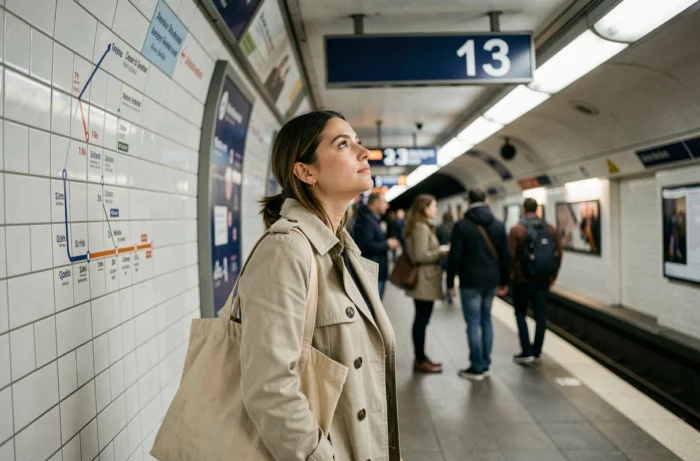
Line 13 of the Paris metro serves 32 stations over approximately 24 kilometers, making it the longest in the network. For anyone considering a move to Paris or its nearby suburbs, choosing accommodation along this line requires weighing parameters that are rarely aligned: peak hour congestion, ongoing modernization work, and variations in comfort depending on the section taken each morning.
Line 13 Works and Replacement of MF19 Trains: The Calendar to Know
The current fleet of aging MF77 trains will be replaced by the new MF19 trains, with service expected to begin in mid-2027. This renewal is not limited to rolling stock: it requires the adaptation of tracks, platforms, access, electrical supply, and signaling systems.
In Châtillon, a new maintenance hall of 3,850 m² and four dedicated tracks has already been put into service to accommodate these trains. The ultimate goal is the complete automation of the line, scheduled for by 2035.
In 2026, partial or total Sunday closures have been planned to prepare for this transition. Some disruptions lasted until noon, with a simple replacement bus covering a limited portion of the route. Anyone looking for an apartment near a station on line 13 must factor in these recurring disruptions in their daily life, at least until the effective deployment of the MF19 trains.
For more information about Carré Presse, a detailed guide station by station helps identify the sections least exposed to service interruptions.
North Section, West or South Branch: Comparison of Travel Conditions
Line 13 splits into two branches to the north (Saint-Denis-Université and Asnières-Gennevilliers Les Courtilles) which merge at La Fourche before crossing Paris to Châtillon-Montrouge. This fork creates radically different transport conditions depending on where you board.

| Section | Peak Hour Congestion | Impact of Works 2026 | Major Connections |
|---|---|---|---|
| Saint-Denis Branch (northeast) | Very high (busy terminus) | Frequent Sunday closures | RER D (Saint-Denis), line 12 (Mairie d’Issy via connection) |
| Asnières Branch (northwest) | High, slightly lower | Occasional Sunday closures | RER C (Porte de Clichy), line 14 (Porte de Clichy) |
| Common Section (La Fourche – Châtillon) | Maximum between Place de Clichy and Invalides | Planned track and platform works | Lines 1, 2, 3, 9, 12, 14, RER C and E |
The common section concentrates all travelers from both branches. Between Place de Clichy and Saint-Lazare, the density regularly reaches levels that make standing travel almost systematic. In contrast, the Porte de Clichy station has benefited since 2020 from a connection with line 14, providing a direct alternative to the center and partially relieving the pressure.
For a newcomer working in the Saint-Lazare or Champs-Élysées area, boarding before La Fourche on the Asnières branch significantly reduces travel stress. The Brochant or Mairie de Clichy stations allow boarding on trains that are still partially empty, whereas the northern terminus sends already full trains onto the common section.
Rental Budget and Neighborhood: What Line 13 Changes for an Expat
Line 13 crosses very contrasting real estate realities. The Parisian stations within the city limits (Liège, Miromesnil, Champs-Élysées-Clémenceau) are located in districts where the rent for a furnished apartment far exceeds the Paris average. In contrast, the municipalities served in Seine-Saint-Denis or Hauts-de-Seine offer significantly more accessible budgets.
- The stations in the 17th arrondissement (Brochant, La Fourche, Guy Môquet) offer a compromise between a lively neighborhood life and moderate rents compared to central Paris, with quick access to Saint-Lazare.
- Clichy and Saint-Ouen (92/93) offer significantly cheaper housing but involve a longer commute and direct exposure to congestion on the northern branch.
- The southern part of the line (Malakoff, Châtillon-Montrouge) attracts with its low prices, but the terminus has a disadvantage: trains arrive full in the direction of Paris in the morning, and the neighborhood remains far from the employment hubs of northwest Paris.
For expatriates or newcomers who prioritize furnished accommodation with a mobility lease, proximity to a well-placed station on line 13 can offset a slightly higher rent. An apartment in Brochant with an eight-minute commute to Saint-Lazare generates less fatigue than a cheaper accommodation at the southern terminus, where travel time and density in the trains weigh on the daily experience.

Automated Line 13 by 2035: Should You Anticipate in Your Neighborhood Choice?
The automation scheduled for 2035 will profoundly transform the operation of the line. The expected benefits of the MF19 (better capacity, increased regularity, reduced noise) will only materialize with the gradual deployment of the new trains starting in mid-2027.
Until then, the line remains marked by congestion, irregularity, and noise. Residential guides rarely mention that the Châtillon site is preparing industrially for this transformation, which suggests an improvement in quality for the southern part of the line in the medium term.
For a move planned in 2026 or 2027, the rational choice remains to favor a post-fork station on the Asnières branch (Brochant, Mairie de Clichy, Porte de Clichy). These stations combine quick access to the center, lower congestion, and the relief of line 14. The southern part of the line will become more attractive as modernization works are completed, but not for several years of construction.