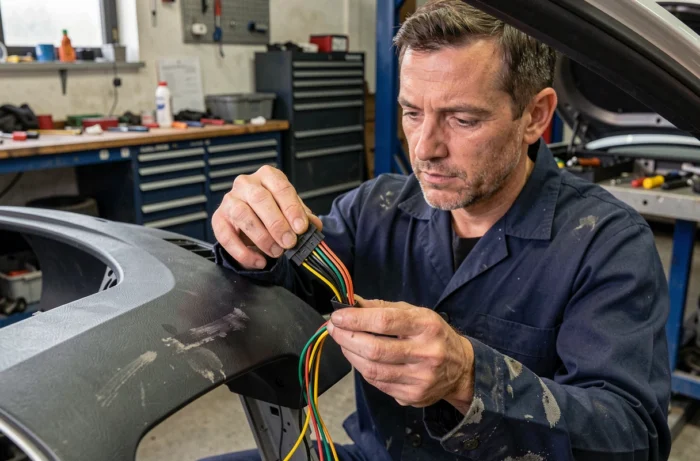
Connecting a car radio to a Peugeot 206, 207, 307, or 308 relies on the same ISO connector, but the actual wiring varies depending on the model year and the type of original unit. Identifying the wire colors is not always sufficient: the presence or absence of the CAN network alters the power logic and makes some generic guides inapplicable. This article compares the electrical specifics of these four models to provide a diagnosis before any intervention.
ISO Correspondence and Differences Between Peugeot Models: Comparison Table
The ISO connector is divided into two blocks: power (block A) and audio (block B). The wire colors follow a standard, but Peugeot applies variations depending on the vehicle generation. The table below summarizes the documented differences.
| Function | Standard ISO Wire Color | 206 (pre-CAN) | 207 / 307 / 308 (CAN) |
|---|---|---|---|
| +12 V permanent (memory) | Yellow | Yellow, physically present | Yellow, physically present |
| +12 V after ignition (ACC) | Red | Red, active physical wire | Red present but managed by the BSI via the CAN bus |
| Ground | Black | Black | Black |
| Antenna / power control | Blue | Blue (single antenna) | Blue (sometimes dual function: antenna + amplifier) |
| Front left speaker | White / white-black | ISO compliant | ISO compliant |
| Front right speaker | Gray / gray-black | ISO compliant | ISO compliant |
| Rear left speaker | Green / green-black | ISO compliant | ISO compliant |
| Rear right speaker | Purple / purple-black | ISO compliant | ISO compliant |
The audio part remains stable from one model to another. It is the power block that poses problems as soon as a CAN network is involved.
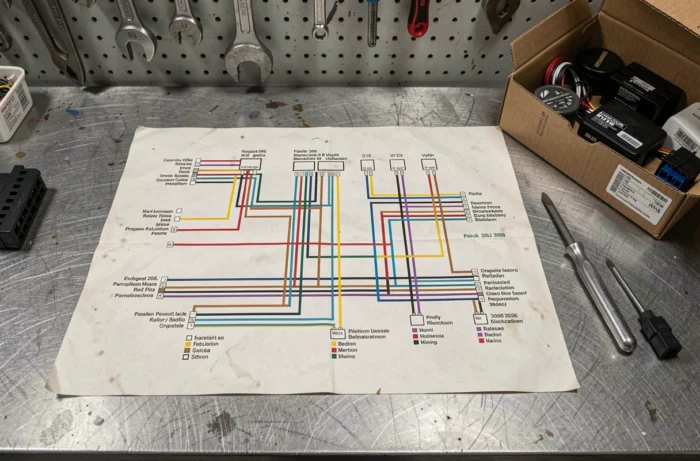
A guide detailing each wiring diagram for Peugeot 206 car radio wire colors and its variations allows for checking wire by wire the compatibility with the chosen unit.
ACC Wire and BSI on Peugeot 207, 307, and 308: Why the Red Wire is No Longer Sufficient
On the 206, the red wire directly carries current after ignition. Connecting an aftermarket car radio means connecting the red wire of the unit to the red wire of the vehicle. The operation works without additional interface.
On the 207, 307 facelifted (from 2005-2006) and 308, the BSI controls the power supply to the car radio location. The red wire physically exists in the connector, but the intelligent service box can cut the power if the CAN bus does not receive a response from the original unit (RD4, RT4, or RT6).
A generic car radio, including an Android model, does not communicate via CAN. The unit receives permanent power via the yellow wire, but the ACC remains inactive without a CAN conversion interface. The result: the unit does not turn on when the vehicle starts, or it turns on and then randomly shuts off.
Error Code B1003 on Peugeot 308
Replacing the car radio with an unrecognized model can trigger the B1003 error code, related to the secure telecoding of the BSI. This error appears after a battery voltage drop or the installation of equipment that the CAN network does not recognize. Its presence confirms that the BSI is waiting for a CAN response from the original unit.
Peugeot CAN-bus Adapter: Choosing the Right Module to Avoid Malfunctions
The CAN-bus adapter converts the vehicle network signals into commands understandable by an aftermarket car radio. It simulates the presence of the original unit to the BSI, restores the ACC power, and transmits commands to the steering wheel.
Not all adapters are equal. So-called “universal PSA” modules practically cause documented problems on the 207:
- Occasional loss of steering wheel controls when the box is intended for another PSA model (Citroën C3 for example)
- Intermittent sound cutouts due to incorrect interpretation of CAN IDs
- Battery drain caused by a module that does not enter sleep mode correctly
Recent guides recommend choosing a PSA-optimized module with a detailed list of supported CAN IDs, rather than a generic box labeled “compatible with all PSA models.”
Blue Antenna Wire: Dual Function on 207, 307, and 308
The blue antenna wire sometimes serves two roles on these models: powering the radio antenna and sending a control signal for an external amplifier. Directly connecting this wire to the antenna output of an aftermarket unit can overload the output if the amplifier draws too much current. An intermediate relay or a dedicated Peugeot antenna adapter avoids this risk.
Electrical Checks Before Connecting a Peugeot Car Radio
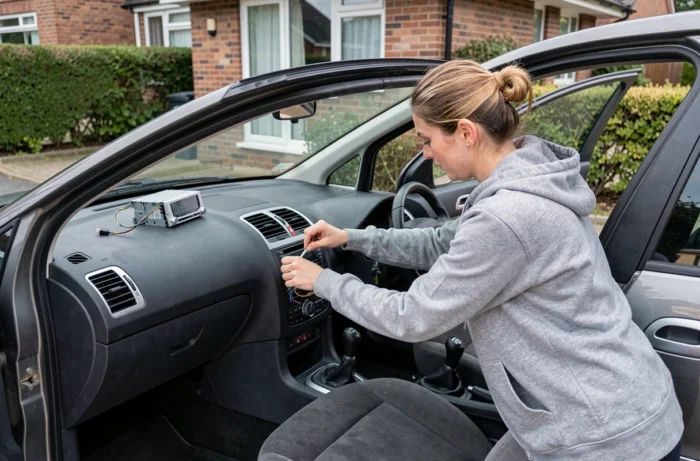
Before connecting a new unit, a few measurements with a multimeter can help avoid the most common mistakes.
- Check the voltage on the yellow wire (permanent): the value should remain stable, engine off, ignition off
- Measure the red wire (ACC) with the ignition on: on a 206, the voltage appears immediately; on a 207/307/308, the absence of voltage confirms CAN management by the BSI
- Test the continuity of the black wire (ground) to the chassis to rule out a bad connection
- Check the condition of the fuses related to the audio unit, especially on used vehicles where contact oxidation is common
On used Peugeot 207s, the total cost of a clean integration (Bluetooth car radio, adaptation harness, CAN interface for steering wheel controls, installation) usually falls within a range of a few hundred euros, with labor billed at one or two hours.
The 206 remains the most accessible model for a connection without an interface. From the 207 onwards, the facelifted 307, and the 308, using a model-specific CAN-bus adapter is essential for a reliable installation. Ignoring this network layer exposes one to recurring malfunctions that simple adherence to the ISO color code will not resolve.