Astrée Lhermitte-Soka is a French painter who trained at the Savannah College of Art and Design (SCAD) in Georgia, United States, where she earned degrees in graphic design and illustration. Her body of work is structured around long-running series, with painting titles playing a central role: through wordplay and literary references, they function as narratives in their own right.
Titles and wordplay: when Astrée Lhermitte-Soka’s paintings are as much read as they are seen
For Astrée Lhermitte-Soka, the titles of her paintings play a full part in shaping their meaning. They are not added to the image as an afterthought; instead, they extend its interpretation through wordplay and literary references.
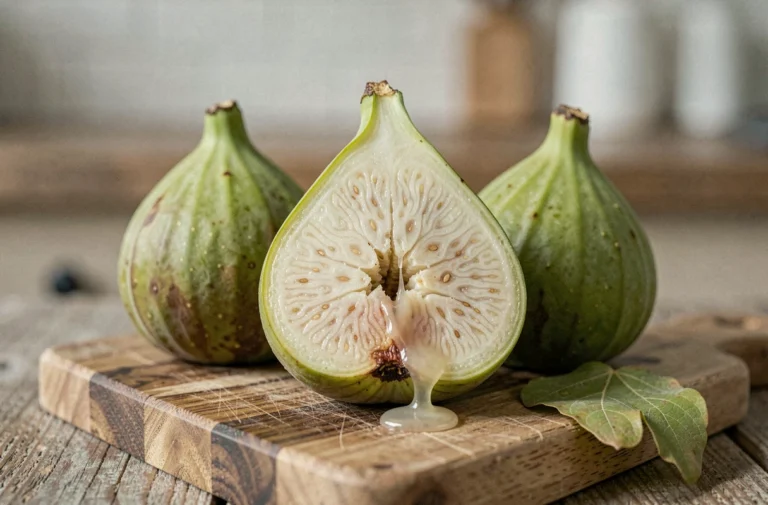
Consider a few examples. Les quatre coings d’un monde (The Four Quinces of a World) substitutes the fruit for the geometric corner, opening up a double reading between space and nature. Treize lunes et autant de savonnettes à l’iréos (Thirteen Moons and Just as Many Iris-Root Soaps) evokes an ancient aromatic material—the iris root used in soapmaking—to speak of the passage of time. La Semaine des quatre jeudis (The Week of Four Thursdays) draws on a proverbial expression associated with the impossible.
These titles do not simply decorate the paintings. They guide the viewer’s interpretation, introduce a shift in perspective, and sometimes allude to literature (Cesare Pavese is among the authors cited as influences on her world). Reducing her work to Astrée Lhermitte’s biography without addressing this linguistic dimension means missing half the story.
Art education in the United States: from graphic design to painting
Astrée Lhermitte-Soka studied at the Savannah College of Art and Design, a school renowned for its visual arts and design programs. There, she developed expertise in both graphic design and illustration—disciplines that require a strong command of the relationship between text and image.
After graduating, she lived in New York for several years, working as a graphic designer. Her time in the United States was followed by a stint in film as a makeup artist, before she made a definitive shift to painting.
This unconventional path sheds light on her current practice. Graphic design taught her to think of the title as a visual element, not merely a caption. Film makeup, a discipline of transformation through successive layers, resonates with the way she builds pictorial series, with each painting adding another layer to the overarching narrative.
Astrée Lhermitte-Soka’s painting series: Otom Potom and other bodies of work
Astrée Lhermitte-Soka’s work is not presented as a collection of standalone pieces. It is organized into long-running series, each exploring a particular theme over several years.
The Otom Potom series
Begun in 2009, the Otom Potom series is reportedly still ongoing. Its title borrows a Serbo-Croatian expression, immediately placing the project in a multilingual context. The series explores language and the wounds of existence—two threads woven together by the titles of individual paintings.
Choosing a title in a foreign language for a body of paintings is no trivial matter. It puts viewers in a position of linguistic unfamiliarity, prompting them to look before they try to understand.
Other documented series
Among the bodies of work mentioned in available sources are:
- Doux-sœur (Sweet-Sister): a title that plays on the homophone of “douceur” (sweetness), introducing an emotional and familial dimension to the series
- Les robes porte-bonheur (The Lucky Dresses): the pairing of an everyday garment with a superstition creates a space between the mundane and the symbolic
- Hexagone exigu (Cramped Hexagon): the geographical reference to France (the Hexagon), qualified by “cramped,” suggests a reflection on territory, confinement, or national identity
Each series title functions as a statement of intent. The name comes first and shapes how the paintings are received, setting this approach apart from purely formal painting.
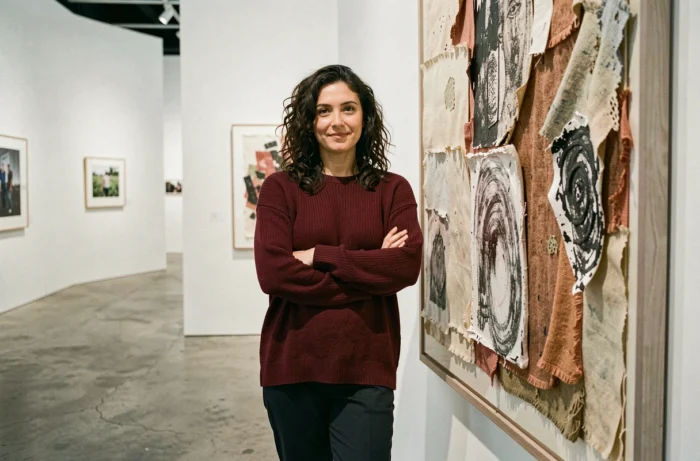
Artistic lineage: Thierry Lhermitte and family heritage
Astrée Lhermitte-Soka is the eldest daughter of actor Thierry Lhermitte and his wife, Hélène Aubert. She grew up alongside her brother Victor and sister Louise (known as Lonny). Her paternal family includes several figures associated with the arts and sciences: the painter Léon Lhermitte, the neurologist Jean Lhermitte, and the neurologist François Lhermitte are among her ancestors.
This family background partly explains why the celebrity press takes an interest in her, but her artistic career has developed away from the spotlight. Choosing SCAD over a Parisian art school, spending several years in New York, and working in film makeup: each stage reflects a determination to forge an independent path.
In her personal life, Astrée is the mother of a daughter named Alice, born from her relationship with N. Soka, whose name forms the second part of her artist’s surname.
What Astrée Lhermitte-Soka’s paintings lose without their titles
Introducing this artist solely through her family biography means overlooking what makes her work distinctive. Online competitors structure their articles around Thierry Lhermitte, the family’s children, and her father’s illness. The paintings are treated as a biographical footnote, a line on a résumé.
The problem with this approach is tangible. A painting titled Les quatre coings d’un monde, reproduced without its title in a celebrity slideshow, becomes just another canvas. With its title, it opens up a web of connections between botany, geometry, and cosmology. The title turns the painting into a riddle to be solved.
Reduced to “she paints,” the Otom Potom series loses its multilingual dimension and its grounding in time. The references to Cesare Pavese disappear. The exploration of language, which sets Astrée Lhermitte-Soka apart from traditional figurative or abstract painting, becomes invisible.
This artist creates narrative paintings whose stories unfold as much through words as through pigments. Without their titles, the paintings lose half of their meaning-making framework.