A couple planning their wedding in 2026 no longer spends their evenings flipping through paper catalogs. They manage a dedicated website, coordinate a digital gift list, brief a content creator in addition to the photographer, and check the administrative documents required by the town hall. Weddings are now organized as a full-fledged digital project, with logistics that far exceed just choosing decorations or the wedding dress.
The platform wedding: centralized website, gifts, and content
We are seeing more and more couples build a true digital ecosystem around their celebration. The wedding website no longer serves just to display the access plan and menu. It consolidates the gift list, RSVP form, accommodation information, and sometimes even a minute-by-minute schedule for guests.
What is changing concretely: the gift list favors experiences and cash funds rather than dishes or household linens. Couples direct their loved ones towards contributions for the honeymoon, a dinner at a specific restaurant, or a cooking class for two. Specialized platforms allow these options to be combined on a single page, with integrated payment.
On the content side, the couple hires a dedicated content creator for social media, in addition to the traditional videographer. This provider produces short formats designed to be shared within hours of the ceremony. You can learn more about Wedding News to see how this trend is developing among French providers.
The result: a wedding where the digital dimension is considered from the outset, not added at the last minute.
Administrative constraints and access to marriage in France
The digital logistics would be just a gadget if it did not accompany a changing administrative context. In France, the question of the right to marry for undocumented individuals has returned to the National Assembly, brought forward by the government. This topic, rarely addressed in articles about trends, is nonetheless altering the conditions for accessing the civil ceremony for part of the population.
For binational couples or those in irregular situations, compiling the file at the town hall remains an obstacle course: proof of residence, certificates of custom, publication deadlines for bans. The digitization of procedures varies greatly from one municipality to another, and feedback on this point varies according to the town halls.
In the United Kingdom, the government recently clarified the rules governing places of celebration (castles, cruises, seaside venues), paving the way for more flexible ceremony formats. In France, the framework remains more rigid for the civil ceremony, which must take place at the residence town hall. The secular ceremony, on the other hand, offers total freedom regarding the location but has no legal value.
Reception and decoration: what couples really choose this year
On the ground, decoration and ambiance choices reflect two parallel movements. The first leans towards a minimalist style, with clean lines, muted colors, and few accessories. The second embraces a more elaborate aesthetic, inspired by rococo or bold glamour, with drapes, mirrors, and imposing floral arrangements.
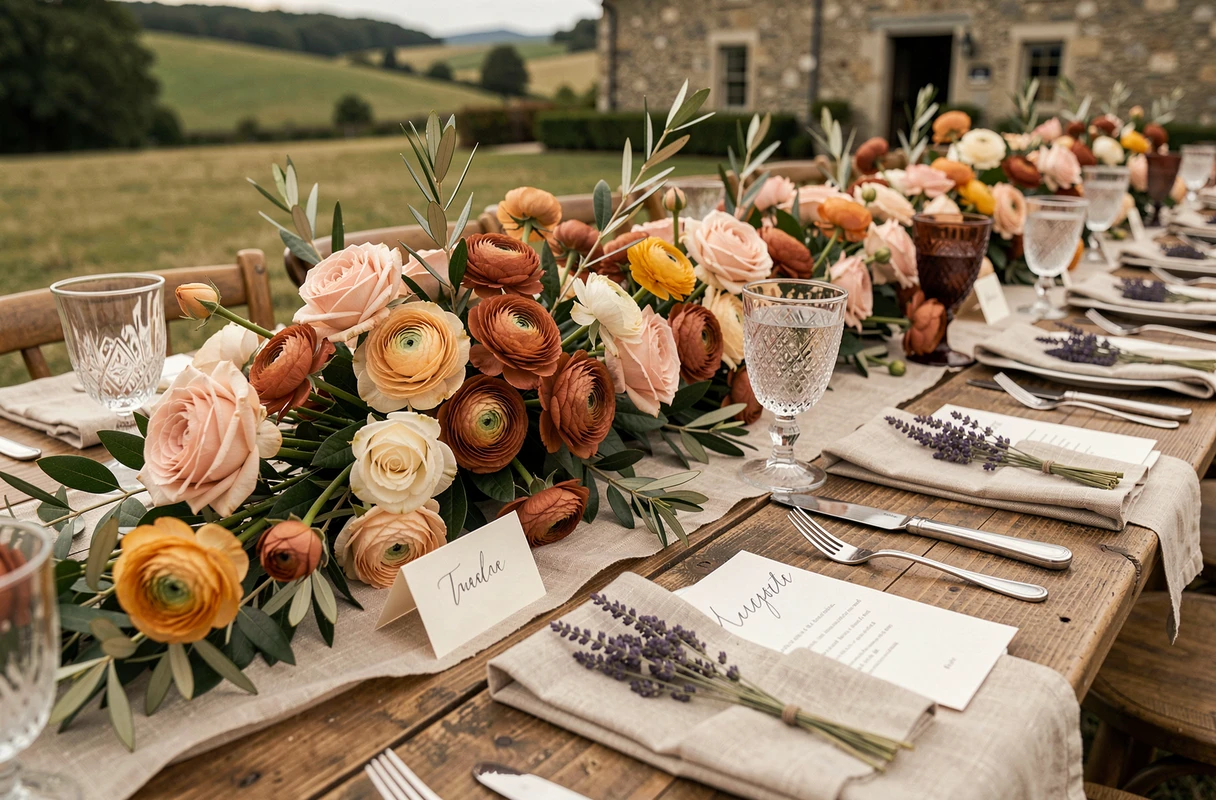
- Neutral and powdery palettes are losing ground to bold colors (burgundy, terracotta, fir green) or strong black and white contrasts
- Floral walls and balloon arches are being replaced by more sculptural installations, often reusable or rented
- Generic guest favors (sugar almonds, candles) are giving way to personalized attentions related to the venue or the couple’s story
The format of the reception is extending over time. Multi-day celebrations are gaining popularity, including outside of traditional destination weddings. A dinner the night before, the ceremony and party on the big day, a brunch the next day: this format allows for spreading moments of conviviality without overloading a single evening.
Wedding budget and choice of providers: making decisions without suffering
The average budget for a wedding in France has nearly doubled in twenty years. This inflation affects all categories, but some account for most of the increase: the reception venue, catering, and photo-video capture.
The category that is discreetly exploding is content production. Hiring a photographer, videographer, and content creator now represents a triple image budget where one provider used to suffice. To make choices, some couples opt for a videographer who also produces short formats for social media, thus avoiding multiplying the number of participants.
- The reception venue remains the largest expense, with significant variations between regions
- The caterer absorbs an increasing share of the budget when the format extends over several meals
- The wedding dress and suit represent a stable expense, but the choice of independent French designers is growing against large chains
- Hybrid weddings (in-person ceremony with online broadcasting) remain a niche, but they reduce the pressure on guest numbers
Fashion trends accompany these evolutions. Colorful wedding dresses, once marginal, are gaining visibility thanks to celebrity ceremonies shared on social media. The style of the ceremony directly influences the choice of attire, and vice versa.
Phone-free weddings and reimagined guest experience
A notable recent shift: the unplugged ceremony, without phones. The principle is simple: guests put away their devices during key moments (vows exchange, exit from the ceremony). The couple then collects the professional images and redistributes them via their website or a shared gallery.
This format refocuses attention on the lived moment rather than its capture. In practice, it works better when the couple informs guests in advance (on the wedding website, on the invitations) and places a visible sign at the entrance of the ceremony. Some providers even offer phone check-in at the entrance of the venue.
The guest experience is no longer limited to the table and dance floor. Mobile bars (cocktails, specialty coffee, artisanal ice cream) create points of circulation and meeting. The organization guide for a wedding in 2026 now incorporates these micro-animations as full-fledged categories, not as last-minute extras.
This year’s wedding is managed as much from a screen as from a notebook. Couples who succeed best are those who treat each digital tool as a concrete lever, not as a trend to follow reflexively.