Does women’s size 2XL correspond to size 46, 48, 50, or 52? The answer depends entirely on the brand consulted. In women’s ready-to-wear, 2XL is most often associated with size 46-48 in French sizing, but this correspondence remains indicative. Some brands calibrate their 2XL to a 50/52, while others stick to a strict 46. Comparing measurement charts remains the only reliable method to avoid a return.
2XL women’s measurements: what brands actually measure
When a brand only displays measurements in centimeters without mentioning a FR, EU, or US correspondence, the conversion becomes a risky exercise. Competing guides offer unified charts, but these charts mask a problem: each brand defines its own range of measurements for the same letter.
At some brands, women’s 2XL covers a bust measurement that starts where others already place their 3XL. To learn everything about women’s size 2XL, you need to compare your own measurements to the specific chart of each brand, not to a generic chart found online.
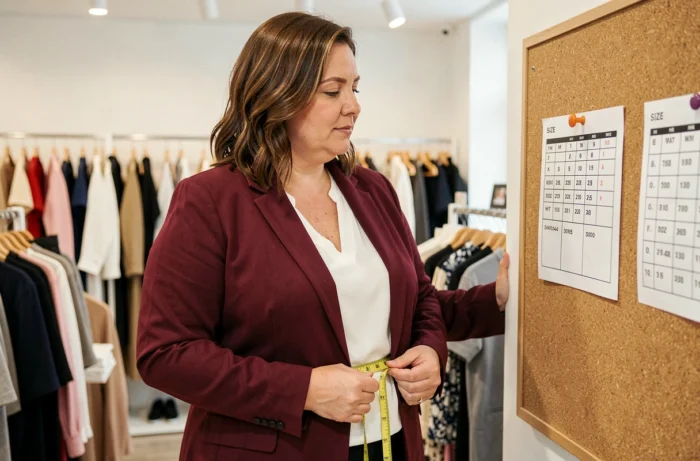
Three measurements are systematically needed for tops:
- Bust measurement, taken at the fullest part of the bust, measuring tape horizontal and not tight
- Waist measurement, taken at the narrowest part of the abdomen, usually above the navel
- Hip measurement, taken at the widest part of the hips and buttocks
For bottoms (pants, skirts), hip measurement often takes precedence over waist measurement in choosing the size. If your measurements fall between two sizes on the chart, always favor the larger size for structured clothing (blazers, dress pants).
2XL women’s size chart: FR, EU, US, and UK sizes
The table below summarizes the most common correspondences for women’s size 2XL. These values represent an average observed across several brands. They do not replace the specific chart of each brand.
| Letter size | FR size | EU size | US size | UK size |
|---|---|---|---|---|
| XL | 44 | 42 | 14 | 16 |
| 2XL (XXL) | 46-48 | 44-46 | 16-18 | 18-20 |
| 3XL | 50-52 | 48-50 | 20-22 | 22-24 |
The discrepancy between French sizes and American sizes is the most common source of error. A US size 16 does not correspond to a French 16: it is roughly equivalent to a 46 FR. This trap particularly affects purchases on international sites that display American sizes without specifying the system used.
In contrast, European sizes (EU) are closer to French sizes, generally with a two-point difference. A 46 FR thus corresponds to a 44 EU in most cases.
Discrepancy between brands for the same 2XL size
Some brands like Mise au Green associate women’s 2XL with a 50/52 in French size. Others, like Stockholm or fast fashion brands, place their 2XL at 46-48. This discrepancy of two full sizes on the same “2XL” label makes any automatic conversion risky.
The reason lies in commercial positioning. Brands that offer “plus size” ranges expand their chart upwards, which mechanically shifts each letter. A brand whose chart goes from XS to XL will calibrate its XL differently from a brand that goes from XS to 5XL.
Choosing your women’s 2XL size when only measurements are displayed
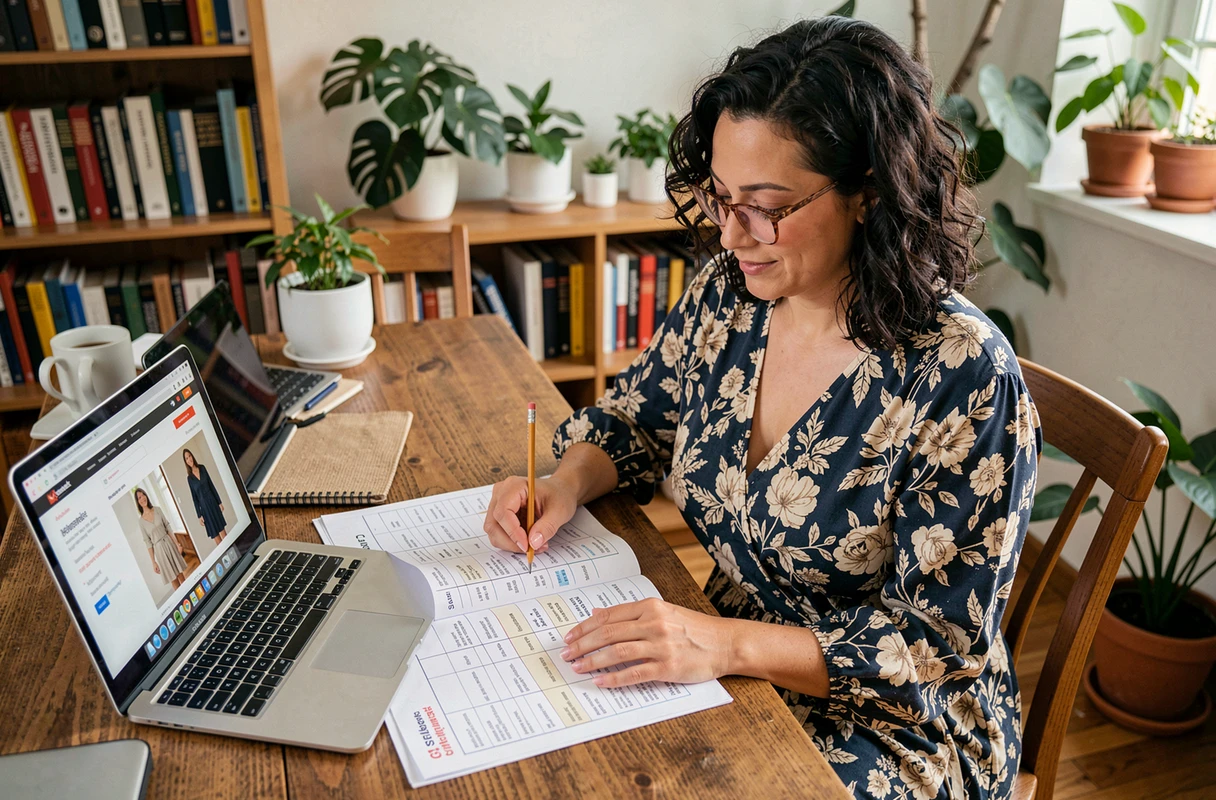
More and more brands, especially on international marketplaces, only display measurement ranges in centimeters. Neither FR size, nor US size, nor UK size. In this case, your three measurements (bust, waist, hips) become your only reliable reference.
The difficulty arises when your measurements do not fall into the same size for all three measurements. A bust measurement corresponding to XL and a hip measurement corresponding to 2XL, for example, is a common case.
- For a top (blouse, jacket, sweater), prioritize the bust measurement, then check that the waist measurement remains compatible
- For a bottom (pants, skirt), the hip measurement is the determining measurement, even if your waist measurement indicates a smaller size
- For a dress or jumpsuit, take the size that corresponds to your largest measurement among the three, even if it means having it adjusted at the waist
- If the gap between your measurements covers more than two sizes on the brand’s chart, this garment is probably not suitable for your body shape in this cut
Common pitfalls when shopping online
Ordering a 2XL from a foreign site without checking the sizing system used remains the most common mistake. An Asian “XXL” often corresponds to a European L or XL. Always identify the country of origin of the chart before confirming an order.
Another trap: the size conversion charts displayed on some sites are generic copies, not the actual manufacturer’s chart. If the site offers a size guide in its help section and a different chart on the product page, rely on the one from the product page, which reflects the specific calibration of the item.
Women’s size 2XL and body shape: beyond the numbers
Raw measurements say nothing about body distribution. Two people with identical bust and hip measurements can have very different body shapes depending on the height of the bust, the length of the torso, or the curvature.
The length of the garment is rarely indicated in standard size guides, yet it conditions the fall as much as the width. A 2XL top designed for a 170 cm silhouette will fall differently on a person who is 160 cm tall, even if the horizontal measurements match.
Brands that detail back length, sleeve length, or inseam in addition to measurements offer much more usable information than a simple letter size conversion chart. When this data is available, it deserves as much attention as the bust measurement.
Ultimately, choosing a women’s size 2XL comes down to a simple habit: measure, compare to the brand’s chart, and ignore generic correspondences. It’s less quick than a universal chart, but it’s the only approach that truly reduces the return rate.