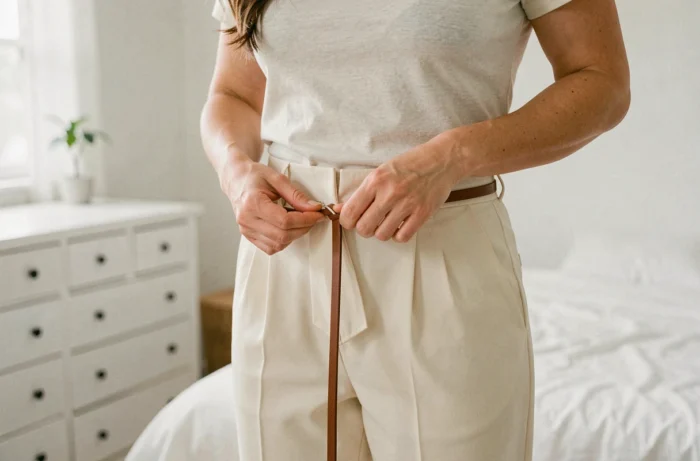
A belt that slips, excess leather that sticks out, or pants without loops that refuse to stay in place: the problem doesn’t always come from the belt itself, but from the incompatibility between the accessory and the garment. Knowing how to fasten a belt without holes or loops requires first understanding why classic systems fail in certain configurations, and then adapting the method to the type of outfit worn.
Belt Width and Loops: The Mechanical Compatibility Issue
Before looking for a fastening trick, it’s essential to check a point that most guides overlook: the width of the belt in relation to the loops. A belt that is too wide for the loops of a pair of pants will bunch, get stuck, or simply refuse to slide. The hold then becomes approximate, regardless of the technique used.
On a standard pair of jeans, the loops generally accept a medium-width strap. Wide belts, often worn as fashion accessories over dresses or coats, are not designed to fit through narrow loops. Choosing a width that is immediately smaller than that of the loops prevents snagging and ensures a smooth fit.
This compatibility issue also explains why some holeless belts, despite being well-adjusted in length, do not stay in place. The locking mechanism (notched, magnetic, or sliding) works correctly only if the strap moves freely through the loops. Excessive friction shifts the buckle and creates slack at the waist. To go further, this page details the actions to take to fasten a belt without holes or loops depending on the type of buckle.

Adjusting a Holeless Belt on Classic Pants
Belt mechanisms with sliding or integrated notches replace holes with a rack hidden under the leather. The buckle attaches by pressing on the notch closest to the desired waist size, offering finer adjustment than a spaced hole system.
For the adjustment to hold all day, the technique of putting it on is just as important as the mechanism itself:
- Pass the strap through all the loops before closing the buckle, never the other way around. Closing first and then trying to thread creates a fold that prevents the notch from engaging properly.
- Gently pull the excess strap towards the back of the pants after locking, to distribute the tension evenly around the waist.
- Fold the excess leather under the first available loop after the buckle, which prevents it from sticking out or flipping over with movement.
On an elastic belt without a metal buckle, the principle differs. The elasticity absorbs variations in waist size, but the hold relies on the friction between the strap and the fastening system (often two pieces that fit together). Overstretching the belt to close it reduces its lifespan and decreases the retention force.
Wearing a Belt on Garments Without Loops
Skirts, dresses, pants with elastic waists: many garments do not have any loops. Placing a belt over without an anchor point results in it slipping down or riding up above the waist with every movement.
Creating an Internal Anchor Point
The most stable solution is to attach an internal clip or pin to the back of the garment, at waist height. This discreet anchor point prevents the belt from twisting or slipping down. A simple flat hairpin, slipped between the strap and the fabric of the garment at the back, is sufficient for occasional use.
For a more durable result, sewing two small fabric loops (improvised loops) inside the garment’s waistband takes a few minutes and transforms any skirt into a belt holder. This method, derived from techniques of seamless dressing, remains invisible from the outside.
The Option of Internal Shaping
On a flowing dress, placing an external belt sometimes creates an unwanted volume effect above and below the strap. An alternative is to maintain a fold at the back of the garment instead of belting the whole thing. This fold, held by a small clip or a temporary stitch, gives a fitted silhouette without requiring a visible belt.
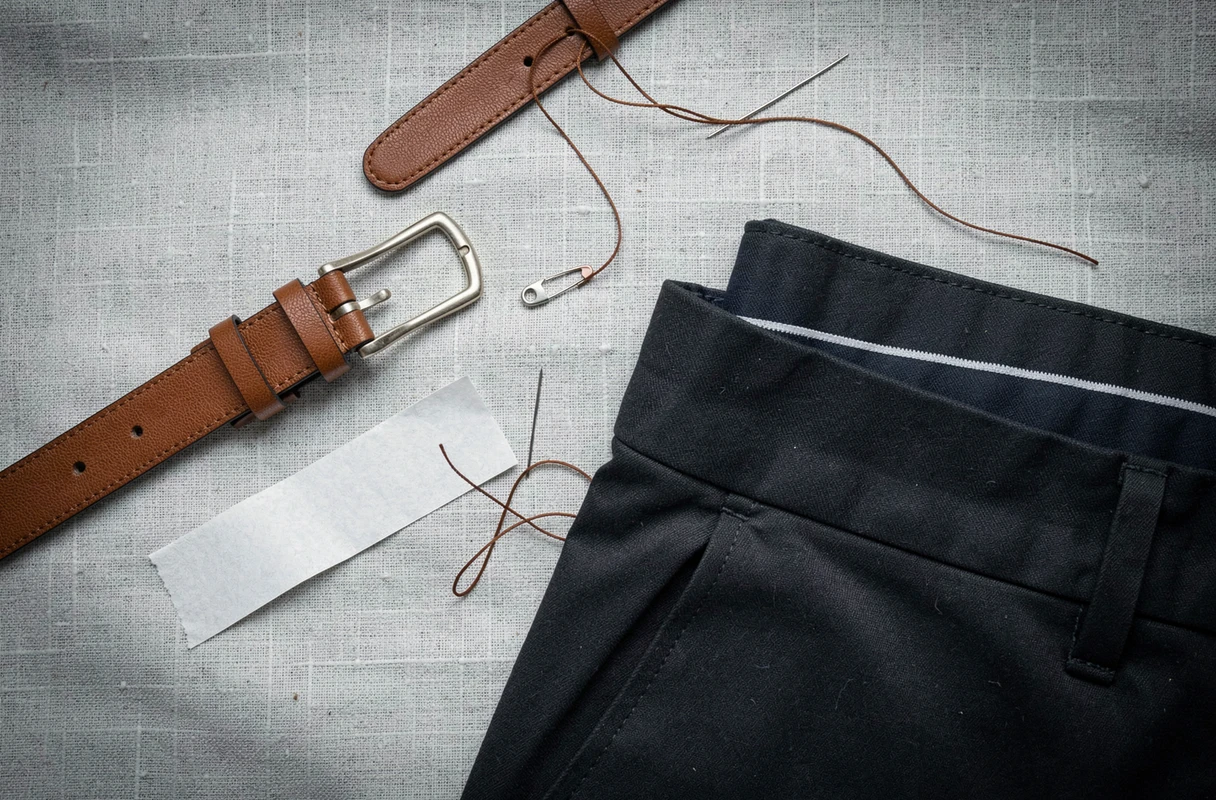
Limits of Temporary Solutions and Waist Alterations
Quick-fix tips (clip, knotted elastic, clip) work for short or occasional use. As soon as it comes to a garment worn regularly, these temporary fixations are less reliable than a structural modification.
Having a tailor take in the waist of a pair of pants generally costs less than a new belt and resolves the problem at the source. Similarly, having the length of a leather belt adjusted by a cobbler (who can remove a few centimeters from the buckle side) avoids multiplying makeshift solutions.
The choice between a temporary solution and a permanent modification depends on the frequency of use. A pair of pants worn three times a week deserves a waist alteration. A skirt worn for an occasion can suffice with an internal clip. Adapting the response to the usage context avoids both an excess of accessories and the frustration of approximate hold.
The reflex to buy a new belt in response to a holding problem often masks a size mismatch between the garment and the body. Resolving this mismatch upstream, through alteration or choosing a mechanically compatible belt, remains the most effective approach in the long term.