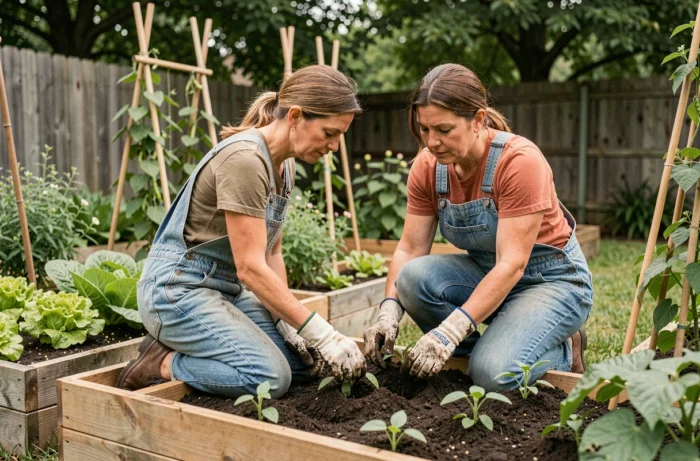
A productive vegetable garden year-round relies less on the accumulation of actions and more on the choice of the right combinations: soil, varieties, and timing. The success of a vegetable garden throughout the year depends on a few decisions made in advance, well before the first sowing.
Adapting your soil to crops without heavy mechanical work
Before choosing what to plant, the soil deserves a simple analysis. Sandy, clayey, or loamy texture determines water retention capacity and ease of rooting. A manual test is sufficient: a handful of moist soil that compacts into a sausage shape without cracking indicates a clayey dominance, while soil that crumbles immediately leans towards sandy.
Permanent mulching effectively replaces repeated digging. A layer of organic matter (dead leaves, branch mulch, straw) retains moisture, limits weeds, and nourishes soil fauna. In winter, this mulch also protects the roots of vegetables left in place, such as leeks or Jerusalem artichokes.
For more information on Conseil au Jardin, several sheets detail soil-crop associations according to regions.
Homemade compost, incorporated on the surface in autumn, gradually improves soil structure without turning it over. On clay soil, it promotes drainage. On sandy soil, it increases water retention. This approach avoids disturbing the mycorrhizal networks that help plants absorb nutrients.
Heat-tolerant varieties: an underestimated lever in the vegetable garden
Episodes of intense heat are recurring in France, and irrigation alone is no longer sufficient to protect certain vegetable crops. Even on irrigated plots, the combination of heat, dry wind, and accelerated evaporation leads to losses, as several producers have observed in recent seasons.
The solution lies in changing varieties. In some French regions, trials are now focusing on species that are more robust against temperature spikes, even on unusual crops for our latitudes. This shift towards less traditional calendars and crop rotations reflects a concrete adaptation.
Varieties to consider for a resilient vegetable garden
- Squashes (butternut, potimarron) tolerate summer heat better than traditional salads and can be stored for several months after harvest, covering part of autumn and winter.
- Pole beans, grown vertically, create their own shade and produce over a long period with moderate watering.
- Mediterranean herbs (thyme, rosemary, oregano) naturally resist drought and remain productive almost year-round in the southern half of the country.
- Old varieties of tomatoes with dense foliage protect their fruits better from direct sunlight than open-pollinated hybrids.
Choosing your sowings based on climate tolerance, and not just taste or yield, profoundly changes the planning of the vegetable garden.
Planning sowings and plantings over four seasons in the vegetable garden
A productive vegetable garden year-round operates in relays. When one crop ends, the next is already in place or ready to take over. This principle of crop succession avoids fallow periods.
Linking crops without downtime
Winter is not a dead season. Lamb’s lettuce, spinach, cabbage, and leeks occupy the ground from November to March. Their sowings are done as early as late summer, in August or September, when the soil is still warm.
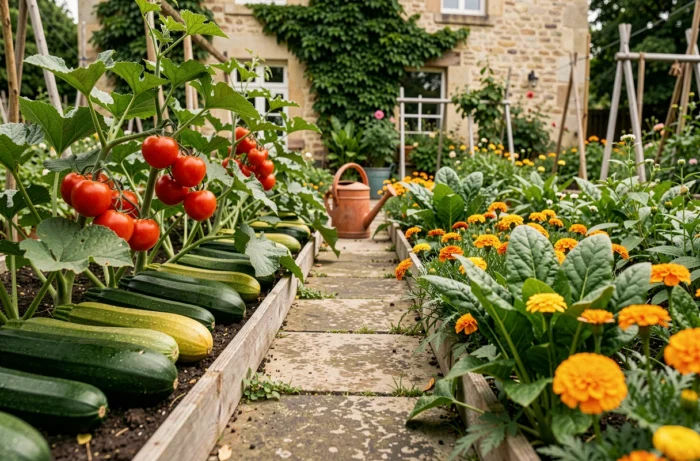
In spring, radishes and salads take up the space freed by winter vegetables. Their short cycle (less than two months) then makes way for summer crops: tomatoes, zucchinis, eggplants. Each plot hosts two to three successive crops per year.
A common trap is to plant everything at once in spring. Staggering sowings of the same species over several weeks spreads out the harvests and avoids waste. Sowing green beans every three weeks from May to July ensures continuous production until October.
Protecting the vegetable garden from the cold without heavy investment
Winter protections do not require a heated greenhouse. A winter cover placed on low hoops is enough to gain a few degrees and extend the harvest season by several weeks. Forcing bells, made of glass or recycled plastic, accelerate the recovery of early sowings as early as February.
The microclimate created by a south-facing wall can make a difference for frost-sensitive vegetables. Leaning against this wall, a glass frame captures daytime heat and releases it at night. This simple technique allows for growing salads and radishes in the middle of winter without any external energy.
Winter soil maintenance
Leaving the soil bare in winter exposes it to erosion and nutrient leaching. Two options exist: thick mulch or green manure. Mustard, phacelia, or rye sown in autumn cover the soil, capture atmospheric nitrogen, and are mowed in spring before new plantings.
- Mustard grows quickly and suppresses weeds but freezes below minus five degrees, making it easier to incorporate in spring.
- Phacelia attracts late pollinators and loosens the soil thanks to its dense root system.
- Rye withstands harsh winters and structures heavy soils but requires early mowing to avoid competing with subsequent crops.
A permanently covered soil produces more than a worked soil left bare. This principle guides the entire management of the vegetable garden, from January to December. The soil should never remain exposed for more than a few weeks between two occupations.