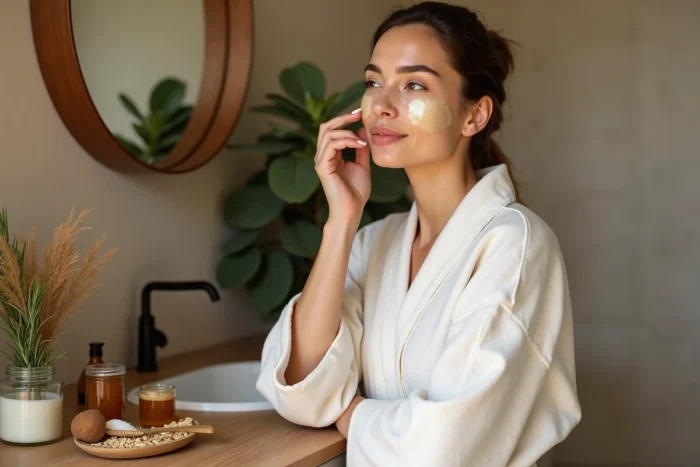
Between touted miraculous vegetable oils and homemade recipes based on honey, natural skincare for the face and body is increasingly appealing. The promise is simple: enhance your beauty daily without resorting to synthetic formulas. However, not all natural ingredients are suitable for all skin types, and some overly complex routines can have the exact opposite effect of what is desired.
Natural skincare and skin tolerance: what the skin truly accepts
The clean beauty trend encourages replacing every conventional product with a natural equivalent. The shortcut is tempting, but skin tolerance doesn’t work that way. A plant-derived active ingredient can irritate just as much as a synthetic compound if the formulation is poorly calibrated or if the skin is not suitable.
Recent content on facial care for sensitive skin emphasizes a specific point: a short ingredient list protects better than a long 100% natural list. The more components a formula contains, the greater the risk of cross-reaction, even with botanical extracts known to be gentle.
Fragrance-free formulas (including those without essential oils) are gaining ground in natural routines. Lavender essential oil, for example, remains a common contact allergen, even though it appears in the majority of homemade recipes. Specialized resources like blogbeaute.fr allow users to cross-reference experiences with this type of formulation before incorporating them into their routine.

Natural ingredients to avoid based on skin type
The trap of “all natural” often stems from a lack of understanding of the interactions between an active ingredient and a skin type. Here’s a table summarizing the most documented incompatibilities:
| Skin Type | Natural Ingredients to Avoid | Why |
|---|---|---|
| Sensitive or reactive skin | Essential oils (mint, cinnamon, citrus), grain exfoliants (crushed apricot kernel) | Direct irritation, micro-lesions, disruption of the skin barrier |
| Oily or acne-prone skin | Coconut oil, shea butter for facial application | High comedogenic index, pore blockage |
| Dry skin | Pure green clay (without added moisturizing agent) | Absorbs residual sebum and increases dryness |
| Mature skin | Pure lemon (juice), undiluted apple cider vinegar | Too acidic pH, photosensitization, weakening of the thinned epidermis |
Coconut oil remains one of the most widespread false friends in natural facial care. While well-tolerated on the body or hair, it clogs the pores of the face in the majority of combination to oily skin types.
On the other hand, jojoba oil has a composition similar to human sebum. It regulates oil production without clogging pores, making it compatible with a much wider range of skin types.
Minimalist beauty routine: three natural steps that suffice
The rise of minimalist routines reflects a fundamental shift. Rather than piling on products, recent approaches prioritize targeted ingredients applied methodically. Three steps cover the majority of daily facial needs.
- Gentle cleansing in the evening with a suitable vegetable oil (jojoba for combination skin, sweet almond for dry skin), followed by a rinse with lukewarm water. Morning double cleansing is unnecessary for most skin types.
- Moisturizing with a product that has a short ingredient list, without added fragrance. Pure aloe vera (cold-stabilized gel) works as a light moisturizing base before a cream if needed.
- Daily sun protection, even in winter. Sunblock is the most effective natural anti-aging treatment, far ahead of serums or masks. Mineral filters (zinc oxide, titanium dioxide) integrate into natural routines without contradiction.
This three-step approach avoids overloading the skin. Multiplying natural actives weakens the skin barrier just as much as poorly dosed conventional products.
The skin microbiome, an often underestimated criterion
Recent research on the skin microbiome is changing the way we evaluate skincare. The skin’s bacterial flora plays a role in regulating sebum, healing, and resistance to aggressions. An overly aggressive cleansing, even with cold saponified soap, disrupts this flora.
Microbiome-friendly formulas prioritize a pH close to that of the skin (around 5.5). Traditional soaps, often touted as natural, have a pH of 9 to 10, far too alkaline for daily facial use.

Natural body and hair care: adjusting textures
What works on the face does not automatically translate to the body or hair. The skin on the body tolerates richer textures and more concentrated actives. Shea butter, discouraged on acne-prone faces, remains an excellent body care option for dry areas (elbows, heels, hands).
For hair, vegetable oils applied as a mask before shampooing yield better results than overnight oil treatments. A 20 to 30-minute application time is sufficient. Beyond that, the oil penetrates little more and weighs down the hair fiber.
Massaging the scalp during application stimulates microcirculation and enhances the absorption of the treatment. A few minutes of massage with the fingertips are enough, without excessive pressure.
Color and natural makeup: care for the base first
Natural makeup relies less on color products than on the condition of the skin underneath. A well-hydrated and sun-protected complexion requires less concealer and foundation. Loose mineral powders, made from natural pigments (iron oxides, mica), offer adjustable coverage without an occlusive film.
For the eyes, mineral-based eyeshadows hold better on a slightly mattified eyelid with a veil of loose powder. No need for synthetic primer.
Everyday beauty with natural care ultimately hinges on a simple principle: know your skin, reduce the number of products, and check the compatibility of each ingredient with your skin type. Fewer products, better chosen, applied to skin with an intact barrier – the rest is marketing.