Staying at home remains the preferred choice for the vast majority of elderly people in France. Behind this preference lies a set of services, devices, and adaptations that allow individuals to age in good conditions without giving up their living environment. Understanding these various levers, their interplay, and their concrete limits helps make choices suited to each situation.
Shared Housing for Seniors: An Alternative Between Home and Facility
Content on aging well often contrasts two options: staying at home or entering a facility like an EHPAD. This dichotomy overlooks a third path that has been developing for a few years: shared housing for autonomous or semi-autonomous seniors.
The principle is based on small living units that bring together a few residents in a common housing arrangement, with private spaces and shared areas. The “8 at Home” concept, promoted by the Fondation Partage et Vie, illustrates this approach. It is presented as a warmer setting than a traditional residence, with an emphasis on social connections and integration into neighborhood life.
These arrangements, sometimes referred to as autonomy villages, meet a specific need: that of individuals who no longer wish to manage a home that has become too large or isolating, but who do not require permanent medical assistance. Platforms like seniorova.fr list this type of solution alongside more traditional home services, making it easier to compare the available options.
The benefits of these shared housing arrangements extend beyond just accommodation. They create a micro-community where daily interactions (meals, outings, activities) occur naturally, without heavy institutional programming. For families living far away, this form of housing alleviates concerns related to the isolation of a parent living alone at home.
Telemedicine in Rural Areas: A Structuring Lever for Seniors’ Autonomy
Telemedicine for seniors goes beyond a simple video appointment with a doctor. Recent feedback, particularly from Charente, shows that its deployment in rural areas transforms daily support when considered comprehensively.
Three dimensions emerge from this field feedback:
- Regular autonomy assessments conducted in collaboration with the attending physician, allowing for the adaptation of support services before a loss of capacity becomes critical.
- A focus on the psychological aspect: supporting the use of digital tools, reassuring against the fear of screens, preventing digital isolation that can compound geographical isolation.
- The integration of telemedicine into a coordinated pathway with home care, independent nurses, and family caregivers, rather than a sporadic and disconnected use.
In rural areas, where the density of healthcare professionals decreases, this type of arrangement avoids exhausting and sometimes impossible travel for individuals with reduced mobility. Telemedicine thus becomes a tool for maintaining daily autonomy, not just a palliative for the lack of doctors.
Cultural Mediation and Social Connection: An Underutilized Angle Against Isolation
Solutions to improve the lives of seniors often focus on health, housing, and financial assistance. The cultural and artistic dimension remains marginal in support systems, even though recent initiatives demonstrate its effectiveness against isolation.
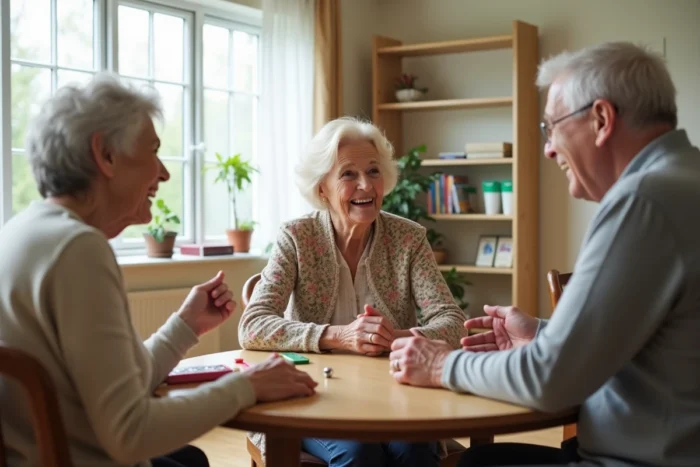
Cultural mediation projects in rural areas invite seniors to participate in theater, writing, or visual arts workshops. These activities are not aimed at artistic performance: they create a regular excuse for outings, meetings, and personal expression.
The isolation of elderly individuals is not just a logistical problem. A person may benefit from home assistance, meal delivery, and teleassistance while still feeling profoundly alone. Cultural activities address this emotional and cognitive dimension that technical services do not cover.
In Eure, a theatrical experience on aging in a rural setting was specifically designed for and with seniors. This type of project involves participants in the creation process, changing their status: they are no longer passive beneficiaries of a service but active contributors to a collective production.
Coordinating Services: The Central Role of Family Caregivers
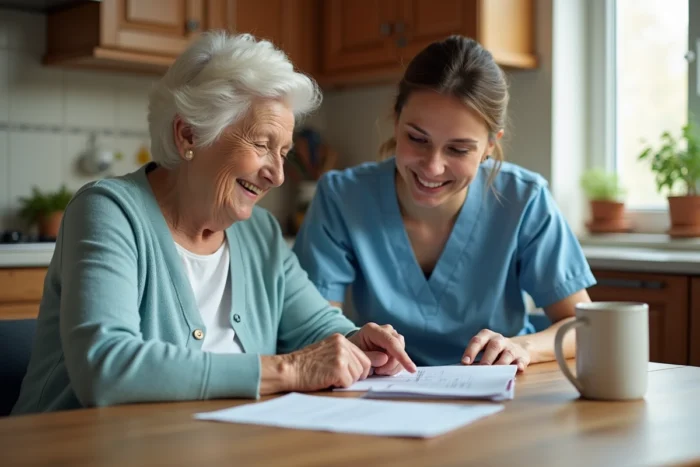
Home assistance, teleassistance, meal delivery, telemedicine, social activities: the proliferation of available services creates a need for coordination that families often underestimate. In practice, it is the family caregivers who handle most of this coordination, often without specific training or support.
Coordinating the schedules of a home helper with those of an independent nurse, managing medical appointments, following up on administrative procedures for financial aid like the APA (Personalized Autonomy Allowance): this organizational burden weighs heavily on family caregivers.
Several concrete avenues can help reduce this burden:
- Utilizing a Home Help and Support Service (SAAD) that directly coordinates the providers, rather than managing each service separately.
- Requesting a needs assessment from the department, which can trigger a personalized support plan and centralize follow-up.
- Identifying local associations that offer support for caregivers (support groups, training, respite).
A well-coordinated support plan protects both the caregiver and the person receiving care. The burnout of the primary caregiver remains one of the leading causes of entry into facilities, even when the senior’s health condition would not yet justify it.
The quality of life of an elderly person depends less on the number of services mobilized than on their coherence. An adapted living environment, regular medical follow-up, authentic social interactions, and a caregiver who does not become exhausted form a set where each element conditions the others. Removing one piece weakens the entire structure.