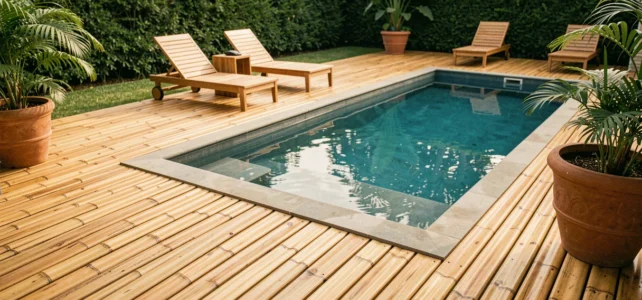
Densified bamboo has established itself in the outdoor decking market as an alternative to exotic woods. Around a pool, the choice of material involves specific constraints: slip resistance on wet surfaces, resistance to chlorine exposure, and dimensional stability in response to humidity cycles. Bamboo ticks several boxes, but not all boards are equal, and some technical criteria remain poorly documented in standard guides.
Slip resistance barefoot: the criterion that product sheets overlook
Most articles on bamboo decking mention slip resistance without specifying the reference standard they relate to. For a pool deck, “shod” tests (DIN 51130 standard, classification R9 to R13) are not sufficient. What matters is the performance measured barefoot on wet surfaces.
The European standard DIN EN 16165:2021, Annex A, which is the successor to the old DIN 51097, classifies coverings into categories A, B, or C based on the slip angle measured under wet conditions. In France, the equivalents PN12, PN18, and PN24 apply. A board intended for the perimeter of a pool should aim for at least class B.
Some manufacturers of thermo bamboo boards publish results ranging from B19 to B22 according to the barefoot standard, which corresponds to a slip resistance considered very good in wet conditions. However, not all ranges communicate this data. Before purchasing, explicitly request the barefoot test report, not just the R11 or R12 class intended for shoes.
Choosing a bamboo deck around the pool requires checking this point in advance, as replacing boards after installation represents a significant cost and project.
Thermo compressed bamboo: understanding the process behind the label
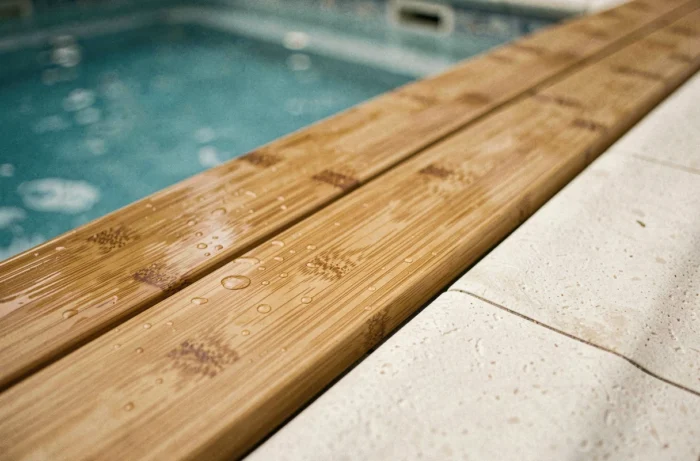
The term “bamboo” covers products of very variable quality. In the outdoor decking market, the technology that has emerged is high-density thermo-treated compressed bamboo, made from Moso bamboo fibers.
The process involves compressing the fibers under high pressure after thermal treatment. This treatment modifies the cellular structure of the material and makes it resistant to fungi and microorganisms, without the addition of biocidal chemicals. The density achieved far exceeds that of conventional softwoods and rivals some exotic woods like ipe.
Three categories to distinguish
- Horizontal or vertical glued bamboo: suitable for indoors (parquet), but too low in density and too sensitive to moisture for outdoor pool use.
- Standard densified bamboo: suitable for sheltered decks or areas with low water exposure, but its performance under repeated immersion remains limited.
- High-density thermo compressed bamboo: the only one suitable for a pool environment, thanks to its dimensional stability and resistance to chlorinated water.
Field feedback varies on the durability of colors over time. Some users notice graying after a few seasons, comparable to that observed on un-oiled exotic woods. Annual maintenance with a suitable saturator slows this phenomenon without completely eliminating it.
Installation by the pool: technical constraints and common mistakes
A bamboo deck around a pool is not installed like a garden lounge deck. The constant contact with water splashes, temperature variations at ground level, and the expansion of the material impose precise rules.
Ventilation and joists
The airflow beneath the boards is crucial. Insufficient space between the supporting slab and the underside of the boards promotes moisture stagnation, the primary cause of premature deformation. The joists themselves must resist moisture: an untreated softwood joist compromises the entire installation.
Specialized manufacturers recommend aluminum or densified bamboo joists to ensure system consistency. Invisible fastening clips, placed between the boards, ensure regular expansion play without visible screws on the surface, which also limits points of contact for bare feet.
Slope and drainage
The deck should have a slight slope directed away from the pool (not towards it). This inclination allows for the rapid drainage of rainwater and splashes and directly contributes to slip resistance by reducing the film of stagnant water.
Bamboo vs. exotic wood and composite: what the carbon footprint changes
Moso bamboo primarily grows in China, which implies long-distance transport. In contrast, exotic woods like ipe come from South America or Africa, with comparable distances. Moso bamboo regenerates without replanting in a few years, whereas a tropical tree takes several decades to reach maturity for harvesting.
The available environmental data (FDES) allows for comparison of life cycle impacts. Composite boards, often presented as a “low-maintenance” alternative, incorporate plastic polymers, and their recycling at the end of life remains problematic. Thermo bamboo, a bio-sourced material, shows a more favorable carbon profile provided that the supply chain is managed.
Field feedback shows that the cost per square meter of thermo compressed bamboo is in a range close to that of class 4 exotic woods and significantly above entry-level composite. The initial extra cost is offset by a lifespan comparable to ipe, without the supply constraints related to the scarcity of tropical species.
- Thermo compressed bamboo: bio-sourced material, rapid regeneration, annual maintenance recommended.
- Exotic wood (ipe, cumaru): very durable, but a slowly renewable resource and regularly increasing prices.
- Composite: low maintenance, but contains polymers and ages differently (no natural patina).
Ultimately, the choice of a bamboo deck around the pool relies on a trade-off between technical performance in a humid environment, environmental consistency, and overall budget including installation. Requesting the barefoot slip test report remains the most concrete reflex to avoid an unpleasant surprise once the boards are installed.