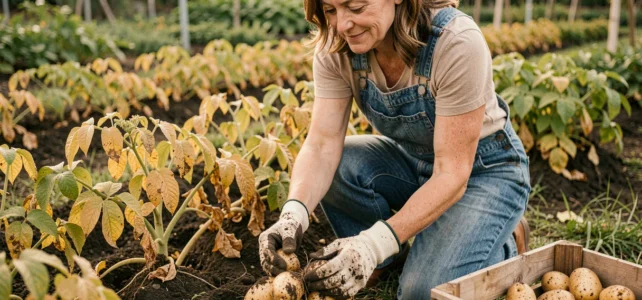
The 2026 potato campaign is distinguished by a distinctly early character. According to forecasts from Agreste published on August 13, 2026, the conservation production is expected to decline compared to the record of 2025, due to a combined effect of reduced acreage and yields. For gardeners as well as producers, this early timing shifts the harvest window and forces a reevaluation of usual benchmarks.
2026 Drought and Heat Stress: What Tubers Endure Before Harvesting
Gardening guides rarely describe the actual state of the soil at the time one decides to dig up their potatoes. In 2026, this question becomes central. Météo-France reports that as of July 22, soil moisture in France reaches values close to the lowest levels ever recorded, with drought worsening since late May.
Such dry soil profoundly alters the harvesting conditions. The earth breaks into hard clumps that damage the skin of the tubers. Mechanical shocks increase, whether working with a fork-spade in the garden or using a harvester in the field.
Water stress also causes physiological defects in the tubers themselves. Arvalis notes that the 2026 climate favors internal anomalies (hollow heart, glassiness) that are not visible to the naked eye at the time of harvest but affect quality during storage. Knowing when to harvest potatoes therefore requires taking into account the soil’s water status as much as the foliage’s maturity.
Yellowing Foliage and Friction Test: The True Indicators of Maturity
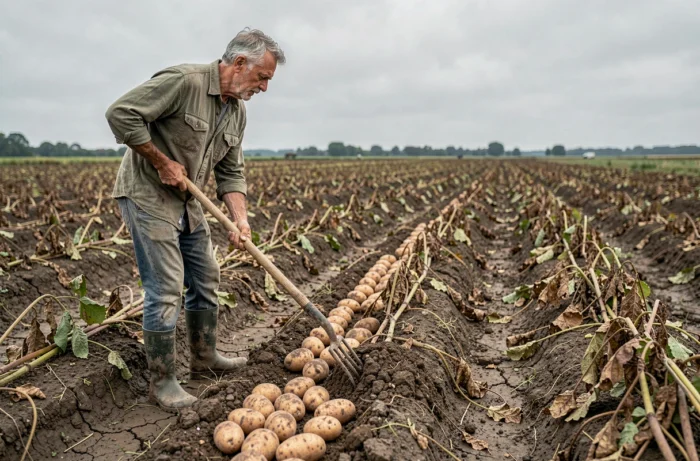
The yellowing of foliage remains the most reliable starting signal. When the stems fall over and the leaves turn yellow on the majority of the plant, the tuber has stopped growing. In 2026, this stage arrives 10 to 15 days earlier than normal in many regions, according to observations reported by the UNPT and FDSEA 80 as early as July 24.
Yellowing alone is not enough. A simple test allows checking the maturity of the skin: rubbing a tuber with the thumb. If the skin comes off easily, the potato is not ready for storage. It can be consumed quickly (this is the “new potato” stage), but it will not keep in a cellar.
Differentiating New Potatoes and Storage Potatoes
New potato varieties are harvested before full maturity, when the foliage is still partially green. Their thin skin makes them fragile, and they should be consumed within days.
Storage varieties require a well “set” skin. After the complete yellowing of the foliage, it is recommended to wait another one to two weeks before harvesting. This delay allows the skin to solidify in the soil, provided that it is not waterlogged (the opposite risk in a rainy year, which is unlikely in 2026).
- Yellow foliage over 80%: the tuber has reached its final size, but the skin may still be fragile.
- Negative friction test (the skin does not come off anymore): the harvest stage for storage is reached.
- Dry and brittle stem: a sign that the plant has completely cut off its exchanges with the tuber, harvesting can begin without delay.
Harvesting in Dry Soil: Methods and Practical Precautions for 2026
With soils as dry as those in summer 2026, harvesting requires some adaptations. In the garden, inserting the fork-spade at a distance from the plant (at least 20 cm) limits impacts on the tubers. Lifting the entire clump rather than scraping the soil avoids tearing the skin.
A moderate watering the day before harvest can make a difference. A few liters per linear meter are enough to soften the surface crust without soaking the soil. Field reports vary on this point: some gardeners prefer to harvest in perfectly dry soil to limit the risk of fungal diseases, while others find too much mechanical damage without prior moistening.
The Timing Matters
Harvesting in the morning, before the soil has accumulated the day’s heat, reduces the risk of sunburn on exposed tubers. A potato left for an hour on soil over 40 °C can develop thermal lesions. In 2026, with repeated heat waves, this risk is particularly high.
Harvested tubers must be placed in the shade immediately, ideally in crates or burlap sacks, never in closed plastic bags that concentrate heat and moisture.
Post-Harvest Storage: Mistakes to Avoid in a Heatwave Summer
A well-executed harvest can be ruined by poor storage. The “curing” phase (air drying after harvesting) normally lasts a few hours. Under heatwave conditions, it should be shortened: do not let tubers dry in direct sunlight for more than an hour.
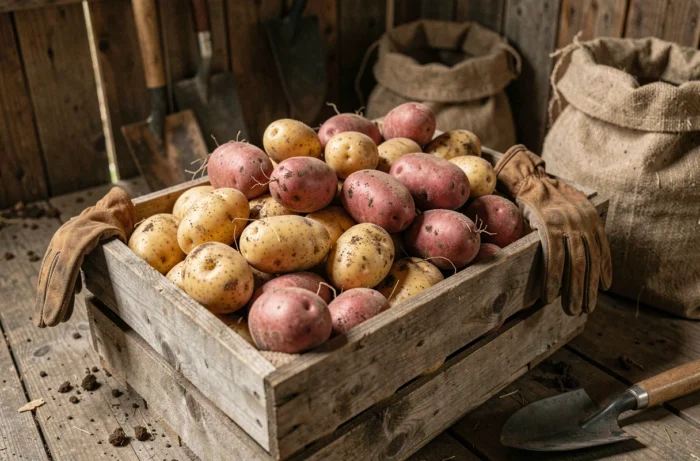
Storage should be in a cool, dark, and ventilated place. Available data do not allow for defining a universal ideal temperature, as it varies according to varieties and intended use (quick consumption or long storage). An underground garage, cellar, or pantry is suitable in most cases.
- Sort immediately: remove injured, green, or soft-spotted tubers to prevent the spread of rot.
- Do not wash before storage: water promotes the development of bacteria and fungi on micro-lesions of the skin.
- Check regularly during the first two weeks: this is the period when storage problems appear most quickly, especially if the tubers have undergone thermal stress before harvesting.
The 2026 campaign imposes a shifted harvest schedule and unusual precautions. The early nature of the season, combined with record drought, makes each step more sensitive than in a normal year. Monitoring the foliage from mid-July, testing the skin before generalizing the harvest, and adjusting schedules to heat peaks: these simple actions determine the quality of what will end up on the plate or in the cellar.