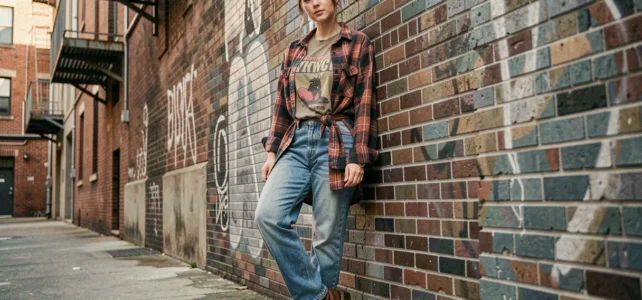
The mid-1990s represent a stylistic turning point that is often misunderstood. In 1994, fashion is neither limited to the fading grunge nor the emerging minimalism: it is precisely at the intersection of the two, in a middle ground that produces hybrid silhouettes, difficult to classify with current frameworks.
When we talk today about a return to the style of 1994, we often observe a frequent confusion between Y2K revival (which draws from the end of the decade) and the specific codes of the mid-nineties.
Cut and textile construction: what separates 1994 from Y2K and minimalism 2026
The distinction first lies in the cut. The silhouettes of 1994 favor a volume concentrated on the upper body: slightly structured shoulders, flannel or viscose shirts worn open over a fitted t-shirt, faded denim jackets with generous proportions. The bottom remains straight or slightly flared, without the pronounced flare of the end of the decade.
Y2K, on the other hand, reverses this logic. The volume migrates downwards (cargo pants, voluminous skirts) while the top becomes smaller (crop tops, fitted tops). In 2026, reinterpretations by Calvin Klein or Marc Jacobs borrow from 90s minimalism with clean lines, fluid dresses, and neutral colors. This style corresponds more to the period 1996-1999 than to the wardrobe of 1994, where raw textures and messy layering still dominated.
To spot an authentically mid-nineties piece in a thrift store or on a resale platform, we recommend checking three indicators: the width of the armhole (wider than a Y2K garment), the length of the garment (tops fall below the waist, not above), and the weight of the fabric, often denser than current productions.
High-waisted jeans and oversized shirts: the 1994 pieces that still work
Not all pieces from 1994 deserve a comeback. Some remain relevant because they meet criteria of cut and proportion that integrate into a contemporary wardrobe without looking costume-like. Others, however, immediately tip into disguise as soon as they are taken out of their original context.
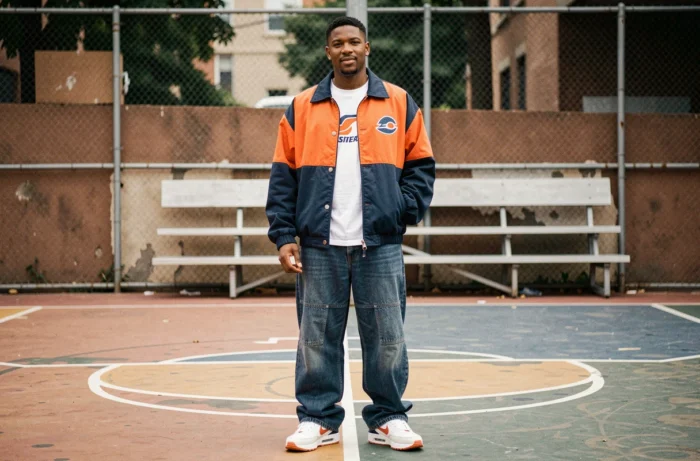
Among those that hold up, the high-waisted straight-leg jeans remain the most transferable piece. Its vertical line and lack of stretch give it a structural rigidity that current jeans do not replicate. Worn with a contemporary top, it anchors the look without dating it. Flannel or thick cotton shirts, worn unbuttoned, also work as long as a proportion is respected: the rest of the outfit must remain fitted.
On the other hand, some typical garments from the era do not transition well:
- Grunge floral print dresses, often in lightweight viscose, appear too literal when worn alone in 2026 and require a structured counterpoint (leather, rigid denim) to avoid a reconstitution effect.
- Denim overalls, ubiquitous in 1994, only work in a very casual context, rarely in an urban setting.
- Chunky vintage sneakers (early chunky type) have been so widely adopted by the market in recent years that they no longer signal “1994” but “trend 2018-2022”.
To delve deeper into the fashion trends of 1994 and identify pieces that retain their stylistic relevance, one must think in terms of proportion and material rather than isolated pieces.
Vintage market and archive pieces: demand has changed in nature
The renewed interest in the style of 1994 is not limited to the runways. Resale platforms are seeing a significant increase in demand for vintage pieces from the 1990s, with a notable shift: archive accessories and shoes attract as much attention as clothing. Fashion media in 2026 report a clear enthusiasm for archive shoes, indicating that vintage inspiration now extends beyond just the textile wardrobe.
This phenomenon alters selection criteria. A buyer in 2026 is no longer looking for a generic “vintage” piece: they target a specific year, a collection, sometimes a precise model. Nostalgia now operates by micro-periods. Searching for “90s fashion” yields results that are too broad for a market that clearly distinguishes between the grunge of 1993, the minimalism of 1996, and the sportswear of 1998.
For both men’s and women’s wardrobes, the most sought-after pieces from 1994 share a common trait: a robust construction and natural materials (heavy cotton, wool, raw denim) that contrast with current fast-fashion production. It is this textile quality, more than the style itself, that justifies the premium in the secondary market.
Integrating the style of 1994 without slipping into historical reconstitution
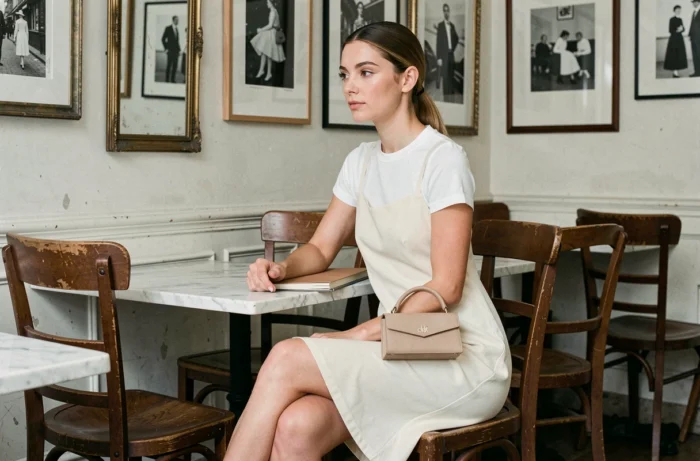
The main trap of the vintage return is to stack the codes of a single period. Wearing a high-waisted jean, a flannel shirt, boots, and a choker simultaneously turns a look into a Halloween costume. The basic rule we apply is: one 1994 piece per outfit, surrounded by neutral or contemporary elements.
The style of 1994 works better as an accent than as a complete system. An oversized faded denim jacket over current tailored pants creates a readable contrast of registers. A vintage graphic t-shirt under a structured blazer anchors the reference without highlighting it.
Colors also play a filtering role. The palette of 1994 (burgundy, forest green, mustard, faded black) is distinctly different from the beige-white-cream of late minimalism. Introducing just one of these shades into a sober outfit is enough to mark the influence without proclaiming it.
The current trend shows that the designers who best succeed in this integration do not replicate 1994: they extract principles (layering, texture contrast, asymmetrical volumes) that they apply with contemporary materials and finishes. It is this approach of principle extraction, rather than piece copying, that separates an informed wardrobe from a retro disguise.